 ultimate-guide
Why Structured Cabling Is Essential for Modern Offices
Last Updated: October 24, 2026
Quick Summary
Why structured cabling is essential for modern offices comes down to establishing a clean, standardised foundation that supports reliable connectivity for voice, data, video, and security systems. Disorganised cabling creates bottlenecks, maintenance nightmares, and expensive retrofits, while proper structured cabling enables consistent performance, straightforward scalability, and systematic troubleshooting.
- Structured cabling uses standardised pathways, patch panels, and components to organise cables for voice, data, video, and security systems throughout a building.
- Proper cabling reduces troubleshooting time from hours to minutes and eliminates costly retrofits when capacity runs out or systems need reconfiguration.
- Horizontal cabling typically uses Category 6 or 6A copper, while backbone cabling uses fiber optic for higher bandwidth between floors or building sections.
- Compliance with AS/NZS 3080 standards requires proper pathways, labelling, fire-stopping, and acceptance testing with calibrated cable analysers.
- Future-proofing requires choosing adequate cable categories, designing with spare capacity in conduits and patch panels, and maintaining clear documentation for system administration.
Table of Contents
- What Structured Cabling Is and Why It Matters
- The Real Benefits of Structured Cabling
- Key Structured Cabling Components You Need to Understand
- Structured Cabling Standards and Compliance
- Structured Cabling for Open-Plan Offices
- Future-Proofing Your Office Network
- Planning Your Structured Cabling Installation
- Frequently Asked Questions
What Structured Cabling Is and Why It Matters
Structured cabling is a comprehensive system of cables, pathways, and components that provides a unified infrastructure for voice, data, video, and security systems throughout a building. Rather than running individual cables haphazardly from device to device, structured cabling organises everything through standardised pathways, patch panels, and connection points. This creates a foundation that's orderly, scalable, and far easier to manage than the tangled mess most offices inherit over time.
Understanding why structured cabling is essential for modern offices starts with recognising the constant demands on network infrastructure. Employees need reliable internet access at their desks, in meeting rooms, and increasingly in flexible workspaces. Security cameras, access control systems, and intercoms all require their own connectivity. Video conferencing has become essential rather than optional. Without proper structured cabling, you're essentially building your network piecemeal, which creates bottlenecks, maintenance nightmares, and expensive rewiring down the track.
Why structured cabling is essential for modern offices comes down to one simple reality: your office infrastructure either supports your business or it constrains it. When cabling is disorganised, troubleshooting takes hours instead of minutes. When capacity runs out, you're facing costly retrofits. When systems aren't properly separated, interference degrades performance. Structured cabling solves all three problems at once by establishing a clean, standardised foundation from day one.
The right cabling infrastructure can transform office operations. It's not glamorous work, but it's foundational. Everything else your business does, from daily communications to security monitoring, depends on it working reliably.
The Real Benefits of Structured Cabling
The benefits of structured cabling extend far beyond simply tidying up cables. When you implement proper structured cabling, you gain consistent network performance across your entire office. Signals travel through standardised pathways with minimal interference, which means faster data transfer and more reliable connections for every device connected to the system.
Scalability becomes straightforward. As your business grows or your office layout changes, adding new connections doesn't require rewiring walls or running cables through attics. New devices connect to existing infrastructure through organised patch panels. This flexibility matters enormously in modern offices where team sizes fluctuate and workspaces get reconfigured regularly.
Maintenance and troubleshooting shift from guesswork to systematic problem-solving. When every cable is labelled and routed through proper pathways, identifying faults takes minutes instead of days. A technician can trace a connection from source to endpoint without hunting through walls or ceilings. This dramatically reduces downtime when issues do arise.
Cost efficiency accumulates over time. While initial installation requires investment, the long-term savings are substantial. You avoid expensive emergency repairs caused by cable failures. You eliminate wasted time troubleshooting poorly organised systems. You extend the lifespan of your network infrastructure because everything operates within proper specifications. Structured cabling also future-proofs your investment, upgrading individual components becomes simple rather than requiring complete system replacement.
Key Structured Cabling Components You Need to Understand
Structured cabling systems consist of several interconnected layers, each serving a specific purpose. Understanding these components helps you appreciate why the system works and what happens when any piece fails or gets neglected.
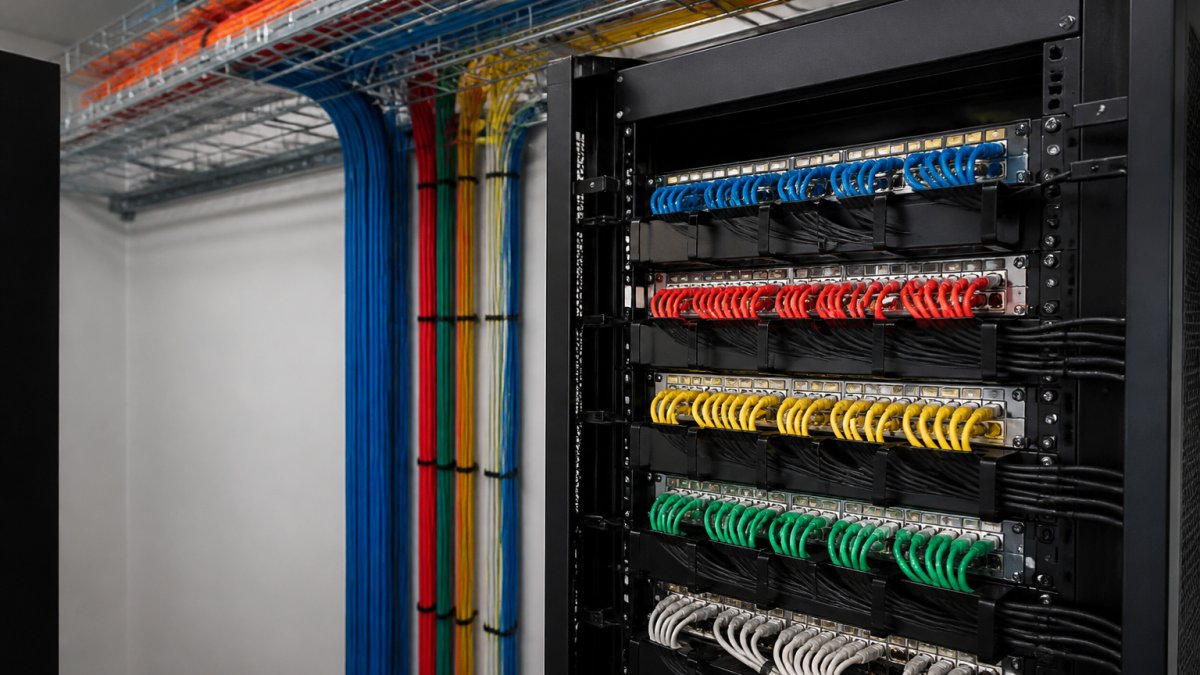
Horizontal cabling runs from the main distribution point to individual workstations, meeting rooms, and devices throughout your office.
Backbone cabling connects different building sections or floors, serving as the main trunk that carries traffic between distribution points. This backbone typically uses fiber optic cabling because it handles much higher volumes of data and can span longer distances without signal degradation.
Patch panels and network racks serve as the physical connection points where individual cables terminate and connect to switches, servers, and other equipment. A well-organised patch panel shows exactly which cable goes where, with clear labelling that prevents mistakes during maintenance or upgrades.
Cable pathways and management include cable trays, conduits, and raceways that route cables through your office in an organised manner. Proper pathways prevent cables from being crushed, kinked, or exposed to interference from power lines.
Power over Ethernet (PoE) infrastructure has become increasingly important as offices adopt wireless access points, security cameras, and IP phones that draw power through the same cable that carries data.
Structured cabling systems rely on several interconnected layers, each serving a specific purpose in your office infrastructure.
| Component | Typical Use | Key Detail |
|---|---|---|
| Horizontal cabling | Workstations and devices | Category 6 or 6A copper, or fiber optic |
| Backbone cabling | Between floors or building sections | Fiber optic for higher bandwidth |
| Patch panels and racks | Connection points for equipment | Requires clear labelling and organisation |
| Cable pathways | Routing cables through office | Trays, conduits, raceways protect cables |
| Power over Ethernet | Wireless access points, cameras, phones | Delivers power and data through same cable |
Structured Cabling Standards and Compliance
Structured cabling doesn't happen in isolation, it must comply with recognised standards that ensure compatibility, safety, and performance. In Australia, the primary standard governing structured cabling is AS/NZS 3080, which aligns with the international ISO/IEC 11801 series and specifies how cabling systems should be designed, installed, and tested. Related standards matter too: AS/NZS 3084 covers pathways and spaces, AS/NZS 3085 addresses administration and labelling, and AS/NZS 3086 deals with testing. Together they define the rules your installation must meet.
What the standards actually require is more specific than most office managers realise. They set maximum horizontal run lengths (typically 90 metres of permanent link plus patch cords), specify bend radii and separation distances from power cabling to limit electromagnetic interference, and define connector and cable performance categories. When you need to electrical compliance checklist for businesses, proper structured cabling is a core component.
Fire safety is a critical compliance consideration. Cables must be routed through approved pathways and use fire-rated materials where required, and penetrations through fire-rated walls and floors must be fire-stopped to maintain the building's fire compartments. In open-plan offices or buildings with specific fire codes, this becomes especially important. Non-compliance can result in failed building inspections and, more critically, safety risks during emergencies.
Proper testing and certification verify that your structured cabling system actually performs to specification. This isn't just theoretical: certified installation includes acceptance testing with a calibrated cable analyser, checking insertion loss, return loss, near-end crosstalk, and, for copper, length and wire-map. Documentation of these tests provides proof of compliance and helps identify potential issues before they become problems.
Structured Cabling for Open-Plan Offices
Open-plan offices present unique challenges for structured cabling because there are no walls to hide cables and no fixed workstations. Flexibility is paramount, employees move desks, teams reconfigure, and spaces get repurposed constantly. Structured cabling designed for this environment must support rapid redeployment without creating chaos.
Cable pathways in open-plan settings typically run beneath raised floors or through overhead cable trays where they're visible but organised. This approach makes it simple to add new connections or reconfigure existing ones without disrupting the entire system. Patch panels must be easily accessible so that connections can be managed quickly as needs change.
Wireless access points become more critical in open-plan offices, but they still depend on structured cabling for their backbone connectivity. You can explore structured cabling solutions for different business environments to see how these principles apply across various settings. A well-designed structured cabling system includes strategically placed access points connected via high-capacity backbone cabling, ensuring consistent wireless coverage throughout the space. This hybrid approach, structured wired infrastructure supporting wireless flexibility, is what modern offices actually need.
Future-Proofing Your Office Network
Future-proofing your structured cabling means building capacity for growth you can't yet predict. Technology evolves faster than most office infrastructure gets replaced, so your cabling system needs to accommodate higher speeds and new applications without complete overhaul.
Choosing the right cable category matters here. Category 6A cabling supports 10 Gigabit Ethernet and handles most foreseeable office applications. Fiber optic cabling offers even greater capacity and is worth considering for backbone infrastructure, especially in larger offices. The cost difference between installing adequate capacity now and retrofitting later is enormous, proper infrastructure costs less than emergency upgrades.
Scalability also means designing your system with room for expansion. Conduits and cable trays should have spare capacity. Patch panels should include extra ports. Distribution points should be sized for growth, not just current needs. This forward-thinking approach saves money and prevents the chaos of running out of capacity mid-project.
Planning Your Structured Cabling Installation
Successful structured cabling starts with proper planning. Before any cables go in, you need a clear understanding of your office layout, current connectivity needs, and anticipated growth.
1. Site survey and requirements capture. Walk the space and record where devices sit today and where they are likely to move.
2. Design and cable selection. Decide horizontal cabling (Category 6 or 6A copper is common; fibre where distance or bandwidth demands it) and backbone cabling (typically fibre between floors and buildings).
3. Routing and labelling plan. Agree cable routes through trays, conduits, and raceways, keeping separation from power.
4. Installation. Cables are pulled to specification, secured without over-tightening, and terminated to the correct category. Fire-stopping is installed at every rated penetration. Racks and patch panels are populated and dressed neatly.
5. Testing and certification. Every link is tested with a calibrated analyser against the chosen category, and results are recorded. Failures are remediated and retested before handover.
6. Documentation and handover. You should receive as-built drawings, test reports, labelling schedules, and warranty information. This package is what lets a future technician troubleshoot without guesswork.
Installation quality directly affects system performance and longevity. Cables must be routed properly, connections must be secure, and everything must be labelled clearly.
Ongoing maintenance keeps your system performing reliably. Many organisations benefit from commercial electrical maintenance contracts that include structured cabling support, ensuring your infrastructure gets the attention it needs without becoming an ad-hoc emergency response.
Professional installation and maintenance also provide benefits of professional electrical inspections specific to your cabling infrastructure.
Frequently Asked Questions
Why is it important to follow a structured cabling standard when installing a network system?
Standards ensure consistency, safety, and compatibility across your entire network infrastructure. Following standards like AS/NZS 3080 means your cabling will support current and future technology, troubleshooting becomes faster and cheaper, and your system remains reliable. It also protects your investment by preventing costly mistakes and making it easier for any qualified technician to work on your network.
What are the main components of structured cabling?
Structured cabling systems include backbone cabling (the main data highways), horizontal cabling (running from backbone to workstations), work-area outlets (where devices connect), and cable management infrastructure like patch panels and conduits. Together, these create an organised, scalable network foundation.
How does structured cabling support business growth and technology changes?
Structured cabling provides the flexibility to add new workstations, devices, and systems without major rewiring. Its modular design means you can upgrade technology, add wireless access points, or integrate new security systems without disrupting existing connections. This scalability saves money and downtime as your business expands or your office layout changes.
Can structured cabling reduce network maintenance costs and downtime?
Yes. Organised cabling with clear labeling and standardised pathways makes faults faster to locate and fix. Proper cable management reduces signal interference and crosstalk, cutting unexpected failures. Preventive maintenance becomes simpler and cheaper. Most businesses report fewer emergency callouts and shorter outages once structured cabling is in place, which directly protects productivity and bottom line.