 ultimate-guide
Electrical Compliance Checklist for Businesses
Table of Contents
- Why an Electrical Compliance Checklist Matters for Your Business
- Workplace Health and Safety Electrical Regulations You Must Follow
- Core Areas of an Electrical Compliance Checklist
- Test and Tag Requirements for Businesses
- RCD Testing Frequency for Commercial Buildings
- Visual Inspections and Smoke Alarm Compliance
- Creating a Preventative Maintenance Schedule
- Frequently Asked Questions
Last Updated: September 16, 2026
Why an Electrical Compliance Checklist Matters for Your Business
An electrical compliance checklist is a documented set of inspection and testing tasks that keeps a commercial property's electrical installation safe, functional and legally aligned. This guide from Auscore Integrated Services covers what belongs on that checklist, how often each task is due, and how to turn it into a maintenance schedule rather than a folder of unread certificates.
The stakes are straightforward.
The Cost of Getting It Wrong
A failed safety switch or a degraded switchboard does not announce itself. It waits.
How a Checklist Prevents Downtime
A checklist converts reactive repairs into planned work. Instead of discovering a failing RCD when a freezer bank trips overnight, you catch it during a scheduled test and replace it before it costs you stock.
Workplace Health and Safety Electrical Regulations You Must Follow
Work health and safety laws across Australia place a duty of care on business owners and managers to provide a safe electrical environment. Obligations vary by jurisdiction, but the core requirements are consistent: identify hazards, control risks, maintain equipment, and keep records.
For a commercial property, this translates into three practical duties:
- Ensure electrical installations are safe and maintained
- Ensure workers who use electrical equipment are trained and supervised
- Keep records that demonstrate both
Core Areas of an Electrical Compliance Checklist
A workable checklist covers seven areas: switchboard and circuit protection, wiring and cabling integrity, power points and outlet safety, lighting and emergency lighting, RCD testing, test and tag, and smoke alarm compliance. Each has its own frequency and failure modes.
Switchboard and Circuit Protection
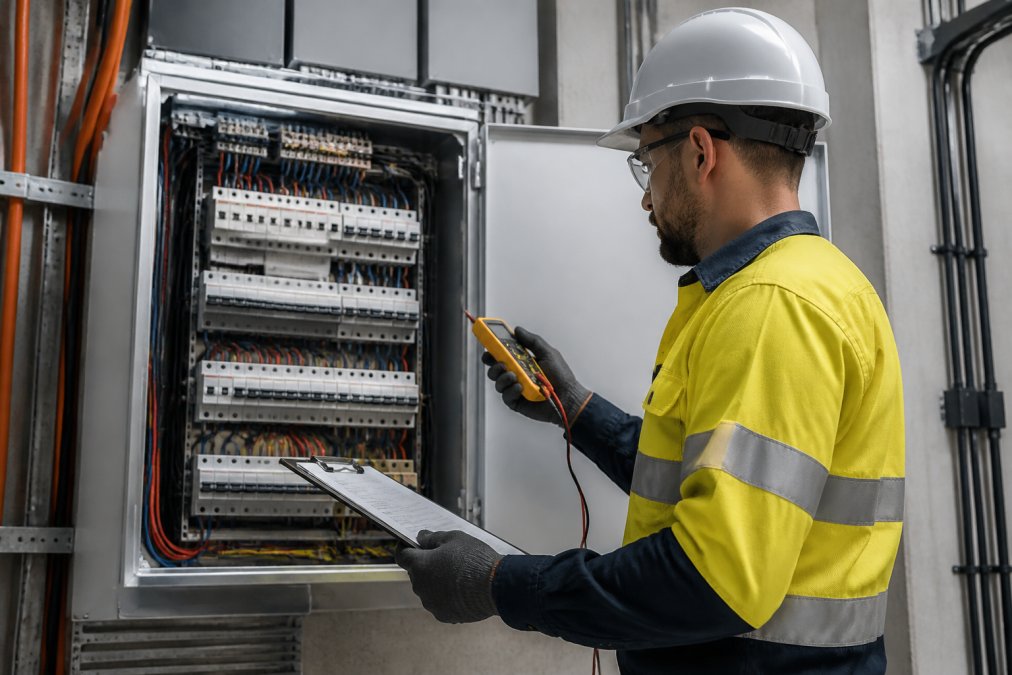
The switchboard is where most serious faults get caught or missed. Visual inspection should check for overheating, discolouration, corrosion, loose connections, and vermin ingress. Circuit breakers should be tested to confirm they trip correctly.
| Checklist Item | Frequency | What to Look For |
|---|---|---|
| Switchboard visual inspection | Annually | Heat damage, corrosion, loose covers |
| Circuit breaker testing | Annually | Correct trip response under load |
| Thermal imaging scan | Annually | Hot spots at terminations |
| Switchboard labelling audit | Annually | Circuits correctly identified |
Wiring, Cabling and Power Point Safety
Wiring integrity is assessed through insulation resistance testing and earth continuity checks, which detect degraded insulation, moisture ingress, and poor earthing before they become shock or fire risks.
Lighting Fixtures and Emergency Lighting
Lighting circuits should be checked for flickering, discolouration around fittings, and water ingress in wet-area fixtures. Emergency lighting and exit signage need their own regime, typically a monthly function test and an annual duration test, because they are life safety systems.
Test and Tag Requirements for Businesses
Test and tag is not a single national rule with one interval. It sits inside your jurisdiction's work health and safety framework and the national standard for in-service testing, which sets out how to classify equipment and how often to inspect and test it. Two businesses on the same street can have completely different schedules because their operating environments carry different risks.
A common pattern for classifying equipment looks like this:
| Equipment type | Environment | Typical inspection and testing interval |
|---|---|---|
| Hand-held power tools | Construction, demolition, outdoor | Frequent, often quarterly |
| Portable equipment | Industrial, workshop, wet or dusty areas | Regular, typically six to twelve monthly |
| Stationary equipment | Office, retail, low-risk indoor | Periodic, often two to five yearly |
| Double-insulated equipment | Any low-risk environment | Longer intervals, visual checks more frequent |
| Equipment used by the public | Hospitality, events, hire | Shorter intervals, often before each use or hire |
What Happens When an Item Fails
A failed test is not the end of the process. The item should be removed from service immediately, tagged as unsafe, and repaired by a competent person or decommissioned. The record should show the failure, the action taken, and the date the item was returned to service or disposed of. Leaving a failed item in circulation turns a compliance program into a liability.
Who Can Test and Tag
Test and tag must be carried out by a competent person, someone with relevant training, correct test instruments, and an understanding of the standard. Many businesses use a licensed electrician or dedicated provider; some larger organisations train in-house staff. Whoever does the work, competence should be documented and instruments calibrated within their calibration period.
RCD Testing Frequency for Commercial Buildings
RCD testing frequency for commercial buildings is typically every six months for the push-button test, with a more thorough trip-time test at longer intervals. The push-button test confirms the device trips; the instrumented test confirms it trips within the required time and current threshold.
Visual Inspections and Smoke Alarm Compliance
Visual inspection is the lowest-cost layer of any compliance program. A monthly walkthrough for damaged outlets, flickering lights, exposed cabling, and overloaded power boards catches many developing faults before they escalate.
Creating a Preventative Maintenance Schedule
A preventative maintenance schedule turns the checklist into a calendar, but the calendar is only the first layer. What competitors miss is what happens when a task fails, how records are kept useful, and how to justify the spend to whoever signs off on it.
Grouping Tasks by Frequency
The most effective schedule groups tasks so a single site visit covers everything due that month, rather than seven separate callouts. A practical structure:
- Monthly: visual walkthrough, emergency lighting function test, smoke alarm test
- Six-monthly: RCD push-button testing, test and tag for high-risk equipment
- Annually: switchboard inspection, thermal imaging, circuit breaker testing, emergency lighting duration test
- Multi-yearly: full installation verification, insulation resistance and earth continuity testing
The Remediation Workflow When Something Fails
This is the part most checklists leave out. A finding without a workflow is just a note. A workable remediation process has five steps:
- Isolate and make safe. If the fault presents an immediate risk, a scorched outlet, a switchboard hot spot, an RCD that will not trip, the circuit or item is taken out of service before anything else happens. This is not a decision for the person who found it to defer.
- Classify the finding. Is it a critical defect requiring immediate repair, a major defect requiring repair within a defined window, or a minor observation to be monitored? The classification drives the urgency and the paperwork.
- Assign responsibility and a due date. Every finding needs a named person and a date. Without both, findings drift.
- Complete the repair and verify. The repair is not complete until it has been retested and the result recorded. A replaced RCD should be trip-tested before the circuit is returned to service.
- Close the loop in the record. The original finding, the action taken, the retest result, and the date of closure all belong in the same record. This is what turns a defect log into evidence of a functioning safety management system.
Digital Record-Keeping That Actually Works
Paper registers fail predictably: they are only useful to the person holding them, and only until they are filed. A digital compliance platform changes the economics of record-keeping in three ways.
The Cost-Benefit Case for Preventative Maintenance
The argument for scheduled maintenance is not that compliance is free, it is that the alternative costs more. A failed safety switch that goes undetected until an incident carries the cost of the incident, downtime, investigation, and potential regulatory action. A thermal scan that catches a hot termination before it fails carries the cost of the scan and a repair.
Frequently Asked Questions
What are the electrical safety obligations for business owners under WHS laws?
Under WHS laws, business owners have a duty of care to provide a safe workplace. This includes ensuring electrical installations are safe, equipment is regularly tested and tagged, and RCDs are functional. You must also maintain compliance documentation and address any identified hazards promptly. Non-compliance can lead to significant penalties and liability.
How often should commercial electrical equipment be tested and tagged?
Test and tag frequency depends on the equipment type and its environment. In construction or manufacturing, testing may be required every three to six months. In office settings, it is typically every twelve months. Items used in hostile environments need more frequent testing. Always refer to AS/NZS 3760 for specific intervals.
What is the difference between an electrical safety audit and routine maintenance?
An electrical safety audit is a comprehensive assessment of your entire electrical system against regulatory standards. Routine maintenance involves scheduled tasks like testing RCDs or replacing faulty components. Audits identify systemic issues, while maintenance keeps systems running safely day-to-day. Both are essential for full compliance.
What documentation is required to prove electrical compliance during an audit?
You need test and tag records, RCD testing logs, switchboard maintenance reports, and certificates of electrical safety for any recent work. Visual inspection checklists and a register of all electrical equipment are also required. Keeping these records organised, ideally in a digital system, simplifies audits and demonstrates your duty of care.