 ultimate-guide
Benefits of Professional Electrical Inspections
Table of Contents
- Why Professional Electrical Inspections Matter More Than You Think
- The Core Benefits of Professional Electrical Inspections
- Signs of Faulty Electrical Wiring You Should Never Ignore
- Electrical Safety Inspection Cost: What Affects the Price
- Electrical Compliance Certificate Requirements for Homes and Businesses
- Insurance Implications and How Often to Schedule Inspections
- What Happens After an Inspection: Understanding Your Report
- Conclusion
- Frequently Asked Questions
Last Updated: September 13, 2026
Why Professional Electrical Inspections Matter More Than You Think
Most electrical faults don't announce themselves. They smoulder behind switchboards, corrode inside walls, and wait. Professional electrical inspections are scheduled assessments of a property's wiring, switchboard, circuits, and safety devices, carried out by a licensed electrician to identify hazards before they fail.
Here's the uncomfortable truth: the average household runs more electrical load than the wiring was ever designed for. Add an EV charger, a second fridge, split-system air conditioning, and a home office, and you're asking decades-old circuits to do a job they were never sized for. An inspection finds that mismatch before it becomes a fire.
This guide covers what a professional inspection actually delivers, what triggers one, what affects the electrical safety inspection cost, and what to do with the report you receive.
The Core Benefits of Professional Electrical Inspections
The benefits of professional electrical inspections come down to four things: safety, cost, protection, and certainty. Below, we break down each one, what it looks like in practice, and, because most guides skip this, exactly what gets tested to deliver it.
Preventing Electrical Fires and Hazard Identification
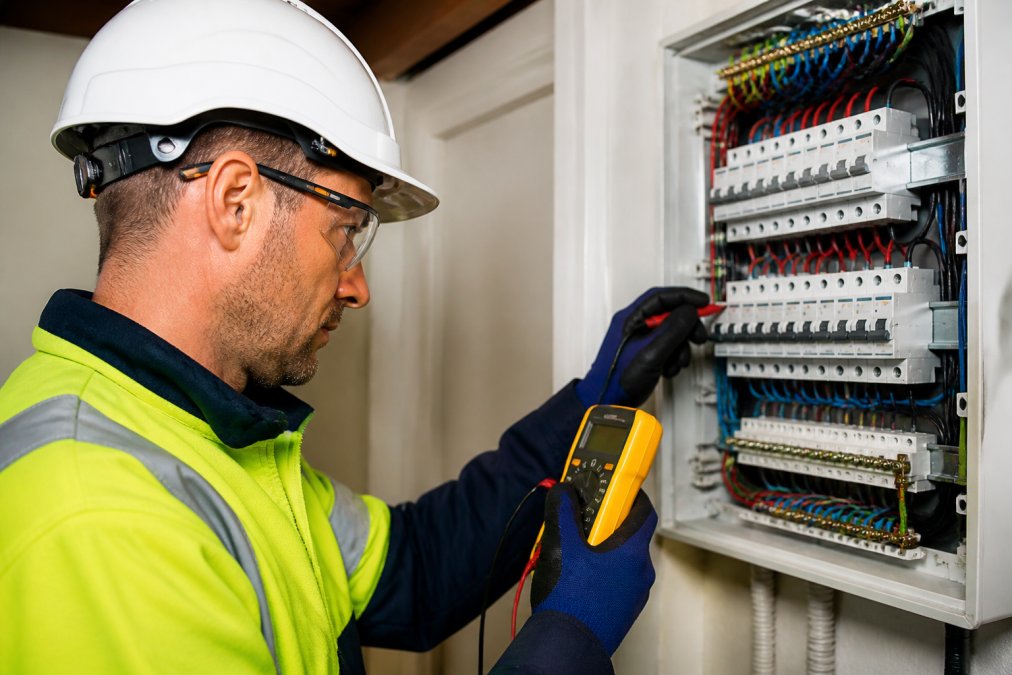
Fires start where heat builds and nothing trips. A loose terminal, an undersized cable carrying too much load, or a circuit breaker that no longer trips at its rated current are all invisible from the hallway. An inspection tests wiring integrity, checks circuit breakers under load, and verifies that residual current devices actually operate within their trip thresholds (What’s new in AS/NZS 4777.1:2024? Key updates for inverter energy systems). Hazard identification is the whole point: you want the fault found on a Tuesday afternoon, not at 2am.
Reducing Energy Bills and Improving Efficiency
Old switchboards, degraded connections, and unbalanced circuits waste power quietly. An electrician can measure voltage drop across circuits and identify where energy is being lost to resistance rather than doing useful work. Fixing those issues, along with upgrading to modern energy-efficient lighting and controls, tends to show up on the next bill. The inspection itself won't cut your costs, but the remedial repairs it identifies often do.
Protecting Sensitive Electronics and Appliances
Power surges and unstable voltage shorten the life of anything with a circuit board inside it. Modern appliances, heat pumps, and inverter-driven air conditioners are particularly sensitive to voltage fluctuation. A properly earthed system with functioning surge protection at the switchboard gives that equipment a stable supply. Grounding and earthing checks are a standard part of any competent inspection, and they matter more now than they did ten years ago (worksafe.qld.gov.au).
What Actually Gets Checked: A Transparent Inspection Checklist
Most articles tell you inspections are a good idea. Few tell you what the electrician actually does. Here is the working checklist a competent inspection follows, so you can hold your contractor to it.
- Switchboard assessment: condition of the board, presence of asbestos-backed panels in older installations, labelling accuracy, and whether circuit breakers are correctly rated for their circuits.
- Main earthing and bonding: continuity of the main earth, bonding of metallic water and gas services, and resistance testing against the maximum permissible value.
- Residual current device (RCD) testing: push-button and instrument trip-time testing to confirm each device operates within its required trip time and current.
- Circuit testing: insulation resistance, polarity, and continuity on socket circuits to detect degraded or damaged cabling.
- Voltage and load checks: voltage drop under load, circuit balance across phases, and whether the supply can carry the property's actual demand.
- Outlet and switch inspection: heat damage, loose terminations, correct polarity, and the presence of an earth on every circuit.
- Accessible wiring inspection: cabling in roof spaces, subfloors, and meter boxes checked for damage, rodent activity, or non-compliant DIY work.
- Smoke alarm and safety switch verification: correct placement, interconnection where required, and function.
The Benefit Most Owners Overlook
The four benefits above are the ones every guide lists. The one they miss is evidence. A documented inspection creates a dated record of the condition of your wiring at a point in time. That record matters when you sell, when you rent, when you claim, and when a dispute arises about who knew what. It converts "the electrician looked at it once" into a defensible paper trail, and that is often the difference between a claim paid in full and a claim negotiated down.
Signs of Faulty Electrical Wiring You Should Never Ignore
The signs of faulty electrical wiring are usually obvious once you know what you're looking at. The problem is that most people normalise them.
Watch for these:
- Circuit breakers that trip repeatedly, especially when a specific appliance starts
- Warm or discoloured power points and switch plates
- A burning smell near the switchboard with no visible source
- Flickering or dimming lights when large appliances kick in
- Buzzing or humming from outlets, switches, or the switchboard itself
- Two-prong outlets with no earth, common in older properties
- Scorched cabling visible in the roof space or under the house
Any one of these warrants a call. Two or more means you should stop using the affected circuits until an electrician has looked at them.
Electrical Safety Inspection Cost: What Affects the Price
There's no single figure for an electrical safety inspection cost, because the price depends on the property, not a flat rate. Here's what actually moves the number:
| Factor | Why It Changes the Price |
|---|---|
| Property size and age | More circuits and older wiring take longer to assess |
| Number of switchboards | Each board needs separate testing and documentation |
| Access difficulty | Roof spaces and subfloors add time |
| Testing scope | RCD testing and circuit testing add labour |
| Remedial work required | Repairs are quoted separately from the inspection |
| Compliance reporting | Certificates and formal reports add administrative time |
For a firm quote, book an assessment. Auscore Integrated Services provides upfront quotes before any work begins, so there are no surprises on the invoice.
Electrical Compliance Certificate Requirements for Homes and Businesses
Electrical compliance certificate requirements vary depending on the work being done and the property type. In general, any electrical installation work requires a certificate of electrical safety, issued by the licensed electrician who performed it (Certificates of Electrical Safety for the community). Landlords and property managers typically need these certificates on file, and they're commonly requested at the point of sale.
For commercial premises, the obligations go further. Commercial compliance often includes periodic testing and tagging of portable equipment, emergency lighting checks, and documented maintenance schedules for common areas. Strata properties have their own layer of requirements around shared infrastructure.
If you're unsure what applies to your property, ask before work starts. A licensed contractor will tell you which certificates apply and provide them on completion. Auscore Integrated Services is registered as Electrical Contractor Number EC16983, and every job is documented accordingly.
Insurance Implications: The Part Most Guides Skip
This is where an inspection earns its keep in ways a checklist can't show. If a fire or fault is traced to wiring that a reasonable owner should have identified, an insurer can reduce or decline a claim. Documented maintenance and inspection records are your evidence that you acted responsibly, and they are the first thing an assessor asks for.
A few practical points worth knowing:
- Claim eligibility: most policies require you to maintain the property in a safe condition. A dated inspection report supports that you did.
- Premium context: some insurers look favourably on properties with documented electrical maintenance, particularly older homes and commercial premises with higher risk profiles.
- Disclosure: if you've had a known defect flagged and not remediated, that is a material fact. Fixing flagged items and keeping the invoice is the cleanest position.
- Rentals: landlords carry additional duty-of-care obligations. An inspection record at each tenancy change is the simplest way to demonstrate it.
How Often Should You Schedule One?
Frequency depends on property age and usage intensity, not a single rule. A practical guideline:
- Owner-occupied homes: every 3 to 5 years, or before buying
- Rental properties: at each tenancy change, plus every 2 years
- Commercial premises: annually, or as required by your compliance schedule
- Older properties (30+ years): every 2 years until the wiring is assessed and upgraded
- After any major renovation or new high-load appliance: before it's commissioned
Solar and EV charger installations deserve a specific mention. Adding a high-draw load to an existing supply requires a proper load assessment, not just a new circuit. If your switchboard hasn't been assessed since the charger went in, that's the next booking.
What to Expect in the Report
A post-inspection report should tell you three things clearly: what was tested, what was found, and what needs doing. Anything less is a receipt, not a report. A competent report will list:
- Every circuit tested, with results
- Any non-compliant items, ranked by urgency (commonly as a risk rating from immediate hazard through to monitor)
- RCD trip times and whether they passed
- Recommended remedial repairs, separated from optional upgrades
- A remedial action plan with suggested timeframes
- The date, licence number, and signature of the inspecting electrician
Read the urgent items first. If the report flags a safety defect, that's not a suggestion to schedule for next quarter. If it lists upgrades as "recommended" rather than "required," you have room to plan and budget. Ask your electrician to walk you through the findings if anything is unclear. A good contractor will.
Insurance Implications and How Often to Schedule Inspections
Insurance implications are the part most guides skip. Here's the short version: if a fire is traced to faulty wiring that a reasonable owner should have identified, an insurer can reduce or deny a claim. Documented maintenance and inspection records are your evidence that you acted responsibly.
How often should you schedule one? A practical guideline:
- Owner-occupied homes: every 3 to 5 years, or before buying
- Rental properties: at each tenancy change, plus every 2 years
- Commercial premises: annually, or as required by your compliance schedule
- Older properties (30+ years): every 2 years until the wiring is assessed and upgraded
- After any major renovation or new high-load appliance: before it's commissioned
Solar and EV charger installations deserve a specific mention. Adding a high-draw load to an existing supply requires a proper load assessment, not just a new circuit. If your switchboard hasn't been assessed since the charger went in, that's the next booking.
What Happens After an Inspection: Understanding Your Report
A post-inspection report should tell you three things clearly: what was tested, what was found, and what needs doing. Anything less is a receipt, not a report.
A competent report will list:
- Every circuit tested, with results
- Any non-compliant items, ranked by urgency
- RCD trip times and whether they passed
- Recommended remedial repairs, separated from optional upgrades
- The date, licence number, and signature of the inspecting electrician
Read the urgent items first. If the report flags a safety defect, that's not a suggestion to schedule for next quarter. If it lists upgrades as "recommended" rather than "required," you have room to plan and budget. Ask your electrician to walk you through the findings if anything is unclear. A good contractor will.
Conclusion
The real question isn't whether you can afford an inspection. It's whether you can afford to skip one and find out the hard way. Faulty wiring, an overloaded circuit, or a switchboard that's past its service life won't wait for a convenient moment to fail.
Auscore Integrated Services handles residential and commercial electrical work, including switchboard upgrades, RCD testing, remedial repairs, EV charger installations, and data cabling, all delivered by fully licensed and insured tradespeople with upfront quotes and a workmanship guarantee. If it's been more than a few years since your last inspection, book now and get a clear picture of what your wiring is actually doing.
Frequently Asked Questions
How much is a full electrical inspection?
The electrical safety inspection cost depends on the size of the property, the age of the wiring, how many circuits need testing, and whether it is a residential or commercial site. A single-storey home with a modern switchboard typically costs less than a multi-level property with outdated wiring. Request an upfront quote so you know the scope before any work begins, and confirm whether testing and tagging is included.
What are the signs that my home needs an urgent electrical inspection?
Book an inspection promptly if you notice flickering lights, frequent circuit breaker trips, a burning smell near power points, buzzing sounds from the switchboard, or discoloured outlets. These are common signs of faulty electrical wiring and can indicate overloaded circuits or degraded insulation. Warm touch plates and mild shocks from appliances also warrant immediate attention from a licensed electrician.
Are professional electrical inspections mandatory for rental properties?
Requirements vary by state and territory, and landlords in most jurisdictions must ensure the property meets electrical safety standards. In many cases, an electrical compliance certificate requirements checklist applies to new installations, alterations, and some rental situations. Check with your property manager or a licensed electrician to confirm what applies to your specific property and tenancy type.
Can an electrical inspection help lower my insurance premiums?
Some insurers ask for evidence of regular preventative maintenance when you lodge a claim, and a current inspection report can support your position. While not all policies offer a direct discount, demonstrating that switchboard upgrades, RCD testing, and remedial repairs are up to date reduces the risk of a denied claim after an electrical fault. Keep your certification and reports on file.