 blog
5 Best Structured Cabling Solutions for Retail Stores
Table of Contents
- Why Structured Cabling Matters for Retail Operations
- Cat6 Cabling for Retail: Speed, Reliability, and Cost Balance
- Fibre-Optic Cabling for Retail Stores: High-Capacity Future-Proofing
- POS System Cabling: Dedicated Infrastructure for Payment Processing
- Integrated Solutions: Cabling for Security, Wi-Fi, and Access Control
- Structured Cabling Installation Cost: Planning Your Investment
- Choosing the Right Solution for Your Retail Environment
- Frequently Asked Questions
Last Updated: October 19, 2026
Why Structured Cabling Matters for Retail Operations
Structured cabling is the backbone of modern retail operations, connecting point-of-sale systems, security cameras, Wi-Fi access points, and inventory tools. Without it, your store runs on disconnected systems held together by temporary fixes.
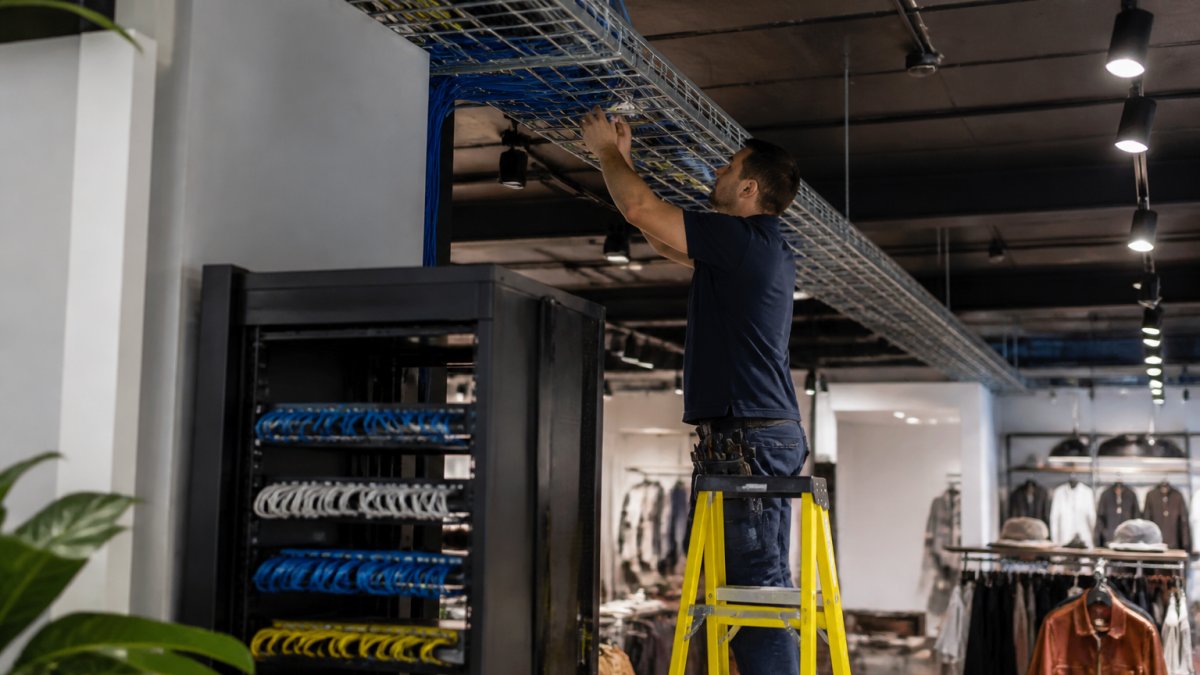
A reliable cabling infrastructure keeps your business running smoothly: transactions process faster, security systems respond instantly, and staff can access inventory from anywhere in the store. The difference between a well-designed system and a haphazard one isn't just speed, it's reliability.
Stores that skip this investment can suffer downtime during peak trading, inconsistent Wi-Fi coverage, and expensive emergency repairs. A structured cabling solution eliminates these headaches by design.
Understanding the 5 best structured cabling solutions for retail stores, each addressing different priorities like speed, future-proofing, payment processing reliability, integrated security, and budget constraints, is the first step toward building infrastructure that actually supports your business. Understanding which solution fits your store's needs is the first step toward building infrastructure that actually supports your business.
Cat6 Cabling for Retail: Speed, Reliability, and Cost Balance
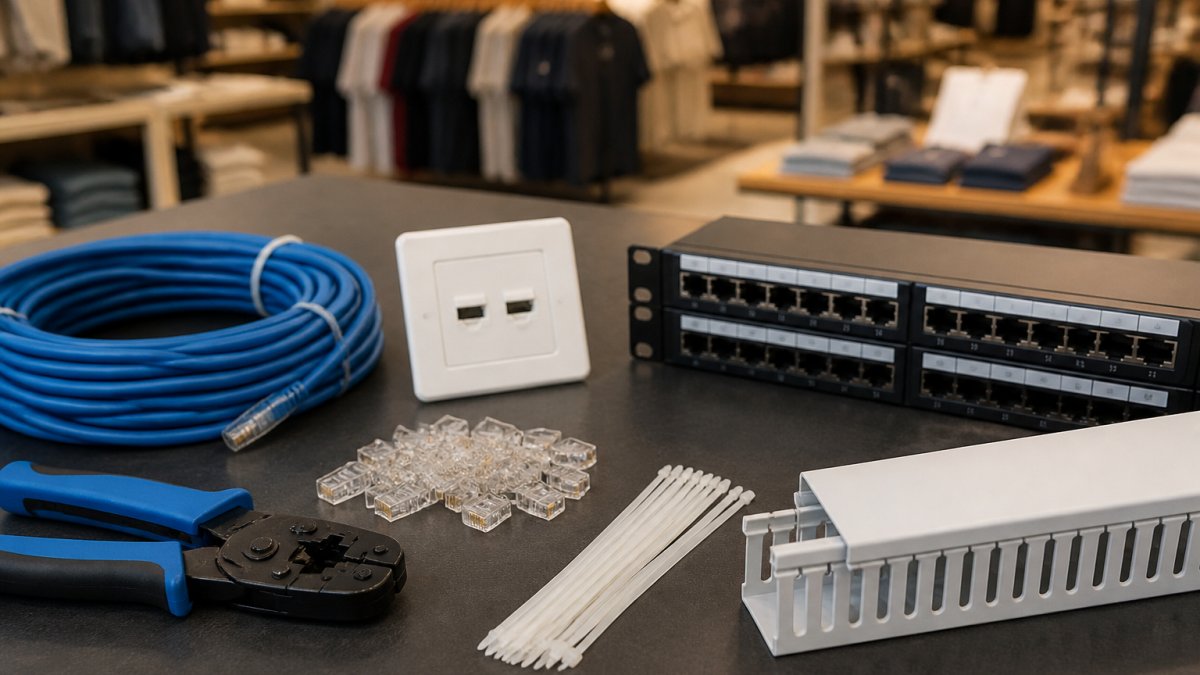
Cat6 cabling delivers gigabit speeds with solid reliability at a reasonable cost. For most retail environments, it's the practical middle ground between older Cat5e systems and premium fibre-optic options.
Cat6 supports up to 10 Gbps over short distances, handling POS transactions, inventory systems, and multiple simultaneous connections without choking. Installation is straightforward and compatible with most existing store infrastructure. It's also stronger than Cat5e, with better shielding against electromagnetic interference from fluorescent lighting and wireless signals.
The real advantage of Cat6 cabling for retail is scalability without excessive cost. You can install it today and expand your network tomorrow without ripping out cables. Most retail stores find Cat6 meets their needs for five to seven years before considering upgrades.
Common mistakes include undersizing cable runs or using cheap connectors, which degrade performance and create intermittent failures that are maddening to troubleshoot. Specifying quality connectors and proper termination is the difference between a system that works consistently and one that works "most of the time."
Fibre-Optic Cabling for Retail Stores: High-Capacity Future-Proofing
Fibre-optic cabling is the premium choice for retailers planning long-term infrastructure investment, transmitting data via pulses of light for vastly higher speeds and immunity to electromagnetic interference.
Fibre-optic systems support 100 Gbps and beyond, far exceeding Cat6. For large chains with multiple locations, centralised servers, and heavy video surveillance, fibre future-proofs your infrastructure against bandwidth demands you haven't even imagined yet.
The trade-off is cost and complexity: fibre requires specialist technicians, pricier hardware, and careful handling. For a single-store retailer the investment may not justify the benefits, but for multi-store operations or those planning significant digital transformation, it becomes the sensible choice.
Installation typically involves backbone cables between equipment rooms, then Cat6 or Cat6A to individual access points. This hybrid approach balances cost with future capacity, and the backbone handles exponential data growth without replacement.
POS System Cabling: Dedicated Infrastructure for Payment Processing
Point-of-sale systems are the one part of a retail network where a brief outage is measured in lost sales and abandoned baskets, not just inconvenience. Generic office cabling treats a POS terminal like any other desk device.
The core principle is traffic separation. When checkout terminals share a switch with staff Wi-Fi, camera streams, and back-office downloads, a firmware update or lunchtime Wi-Fi surge can introduce latency exactly when transactions are authorised.
Redundancy matters most at the checkout. A common pattern is dual-homed POS switches with a redundant uplink, so a single cable or port failure doesn't take down every lane.
Electrical separation is the other half of the job. Data cables run parallel to power feeds pick up interference, showing up as retries, dropped connections, and frustrated staff.
Physical protection is often overlooked. Checkout lanes are high-traffic areas where cables get kicked, trolleyed, and mopped around.
Finally, plan for payment device change. Terminals and self-checkout units are refreshed far more often than the cabling serving them. Terminate POS runs on patch panels and wall outlets rather than hard-wiring devices, so a terminal swap is a five-minute patch job.
The cost of dedicated POS cabling is modest next to payment downtime. A single hour of checkout outages during peak trading typically outweighs the incremental cabling and switch cost many times over, and the separation and labelling work is cheaper during the initial fit-out than as an emergency retrofit.
Integrated Solutions: Cabling for Security, Wi-Fi, and Access Control
Modern retail stores need cabling that supports security cameras, access control, Wi-Fi access points, and data networks through the same physical infrastructure.
Integrated cabling solutions use structured pathways for multiple cable types: network data, power-over-Ethernet for Wi-Fi and cameras, and dedicated security circuits. PoE is particularly valuable because it eliminates separate power runs to cameras and access points, reducing installation complexity and cost.
A well-designed integrated system means cameras draw power through the same Cat6 cables carrying data, Wi-Fi access points mount on the same pathways, and access control integrates seamlessly with your network, all built on one structured foundation.
Planning is critical: map camera locations, Wi-Fi coverage zones, access control points, and POS terminals before cables go in. Retrofit work is exponentially more expensive than getting it right the first time.
Structured Cabling Installation Cost: Planning Your Investment
Cost is where most retail cabling decisions are actually made. Rather than a single headline number, understand the cost structure, the lifecycle trade-offs between the five solutions, and the factors that push a quote up or down.
As a planning guide, most retail structured cabling projects price per outlet rather than per square metre, because labour and termination dominate the cost. A typical single-store installation commonly prices per outlet rather than per square metre, because labour and termination dominate the cost.
The main cost drivers are consistent across retail projects:
- Labour and access. Ceiling type, roof space, asbestos, and whether the store trades during installation all affect labour hours more than the cable itself does. Off-hours work typically carries a premium rate but avoids lost trading revenue, which often makes it the cheaper option overall.
- Cable category. Cat6 is the current retail default. Cat6A costs more in cable, jacks, and patch panels and is harder to terminate, but it supports 10 Gbps over the full 100 m channel rather than Cat6's shorter 10GBASE-T reach. Fibre backbone cabling adds specialist labour and fusion splicing or pre-terminated cassettes.
- Pathways and containment. Cable tray, conduit, floor boxes, and fire-rated penetrations are frequently underestimated. They are also the hardest items to add later, which is why a 20-30% capacity buffer is usually cheaper than a retrofit.
- Testing and certification. Certification testing to the relevant standard, with results handed over as documentation, is a small percentage of project cost but is what makes a warranty and a future fault-finding exercise possible.
- Contingency. Retail fit-outs routinely uncover surprises: undocumented services, structural obstacles, or legacy cabling that must be removed. A 10-15% contingency is normal practice.
Lifecycle trade-offs are where the five solutions genuinely diverge. Cat6 has the lowest upfront cost and a realistic service life of around 10 to 15 years if installed well, but it will need a fibre backbone upgrade sooner in bandwidth-heavy stores. Cat6A costs perhaps 20-40% more upfront and pushes the copper refresh further out.
The cheapest-looking quote is rarely the lowest lifecycle cost. A budget installation that skips certification, uses undersized containment, or omits labelling tends to cost more over ten years through fault-finding, re-patching, and premature replacement. Compare outlet count, cable category, containment allowance, certification, and as-built documentation, not just the total.
Installation timing is a genuine cost lever. Scheduling cabling during a planned refurbishment, when ceilings are open and trades are on site, typically reduces total project cost and avoids a second round of after-hours work.
Choosing the Right Solution for Your Retail Environment
Selecting the right structured cabling solution depends on three factors: your current needs, your growth plans, and your budget constraints.
Start by mapping your current infrastructure: how many POS terminals, security cameras, Wi-Fi access points, and networked devices do you have? Then project forward three to five years: will you open additional locations, expand, or implement new technology systems?
Cat6 cabling suits retailers who need solid performance today without premium pricing. Fibre-optic cabling makes sense for multi-location operations or retailers with aggressive digital transformation plans.
The decision matrix below summarises the five best structured cabling solutions for retail stores:
| Solution | Best For | Speed Capacity | Installation Complexity | Cost Level |
|---|---|---|---|---|
| Cat6 Cabling | Single-store retailers, 5-7 year horizon | 10 Gbps | Low | Budget-friendly |
| Fibre-Optic Cabling | Multi-location chains, future-proofing | 100+ Gbps | High | Premium |
| POS Dedicated Cabling | Payment processing reliability | 10 Gbps (isolated) | Medium | Moderate |
| Integrated Security + Data | Stores needing cameras + Wi-Fi + POS | 10 Gbps | Medium-High | Moderate-Premium |
| Hybrid Approach | Balanced needs, phased growth | 10-100 Gbps | Medium | Moderate |
The 5 best structured cabling solutions for retail stores aren't one-size-fits-all. The right choice depends on your specific store layout, growth ambitions, and technology roadmap. What works for a boutique boutique doesn't work for a supermarket.
Auscore Integrated Services has installed structured cabling systems in retail environments.
Your retail store's infrastructure should support your business operations, not limit them. Structured cabling solutions provide the foundation for reliable POS systems, effective security, and seamless Wi-Fi coverage.
Frequently Asked Questions
What type of cabling is best for a retail store?
The best choice depends on your store size and future needs. Cat6 cabling suits most retail operations, delivering reliable data transmission for POS systems, Wi-Fi access points, and security cameras at moderate cost. Fibre-optic cabling offers higher capacity and future-proofing if you plan significant expansion or operate multiple locations. A structured cabling system combining both, fibre-optic for backbone infrastructure and Cat6 for endpoints, provides flexibility and scalability without over-investing upfront.
How should a retail store plan cabling for point-of-sale systems?
POS system cabling requires dedicated pathways separate from power lines to prevent electromagnetic interference. Plan for redundant connections so payment processing continues if one cable fails. Run cabling through organised cable trays or conduits to maintain signal integrity and simplify troubleshooting. Ensure cable runs from your network switch to each terminal are as short and direct as possible. Consider future register locations when designing pathways, and label every cable clearly for maintenance and expansion.
What cabling is needed for retail security cameras and access control?
Security cameras and access control systems typically use separate Cat6 or Cat5e cabling, though modern systems increasingly use Power over Ethernet (PoE) to simplify installation. Plan cable pathways along the perimeter and interior routes where cameras will be mounted. Access control readers at entry points also need dedicated cabling runs back to your central control panel. Integrate these pathways into your overall structured cabling design during planning to avoid costly retrofits and ensure consistent network reliability across all systems.
How do you future-proof a retail network with structured cabling?
Future-ready infrastructure begins with oversized cable pathways and extra conduit capacity during initial installation. Choose fibre-optic cabling for your backbone to support higher data transmission rates as retail technology evolves. Install Cat6 or Cat6A to endpoints rather than Cat5e, even if current needs don't require it. Label all cables and maintain accurate documentation of your cabling system layout. Plan for Wi-Fi access point expansion and anticipated growth in connected devices, security systems, inventory terminals, and customer-facing displays all demand bandwidth.