 how-to
How to Turn the Main Power Switch Up or Down Safely
Last Updated: October 25, 2026
Quick Summary
In Australia, there is no universal up-or-down rule for the main power switch because orientation depends on switchboard design and installation. The reliable method is to read the ON and OFF markings on the switch or board, not the direction alone.
- The main power switch is the largest switch at the top of your switchboard and controls power to your entire house
- Always check the ON and OFF labels or I and O symbols before operating the main power switch
- Never assume up means ON or down means OFF, as switchboard layouts vary across different installations
- If markings are unclear or missing, call a licensed electrician to identify and label the switch safely
- Turn off the main switch only in emergencies, major electrical work, or extended absences from home
Table of Contents
- Understanding Your Main Power Switch and Switchboard
- How to Identify the Main Switch on a Switchboard
- Switch Position: Does It Go Up or Down?
- How to Turn Off Electricity at the Switchboard
- What Happens When You Turn Off the Main Power
- Understanding RCD Switches and When They Trip
- Electrical Safety and When to Call a Licensed Electrician
- Get Your Switchboard Assessed by a Professional
- Frequently Asked Questions
Understanding Your Main Power Switch and Switchboard
Your home's main power switch is the most important control on your electrical switchboard. It cuts power to your entire house when you need it.
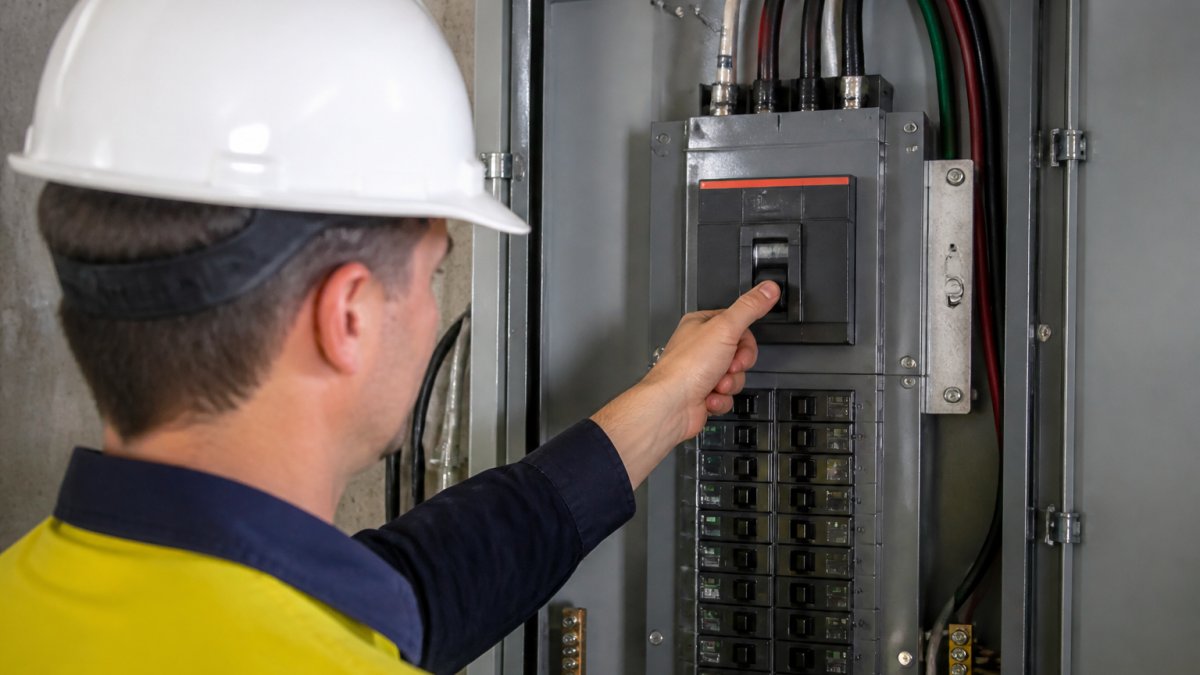
The switchboard itself is a metal box, usually mounted on an outside wall or in a garage. Inside, you'll find the main switch at the top, along with smaller individual circuit switches below it.
Knowing how to operate your main switch is essential. It's one of the first things you should learn about your home's electrical setup.
How to Identify the Main Switch on a Switchboard
Finding the main switch is straightforward. It's always the largest switch on your switchboard, positioned at the top.
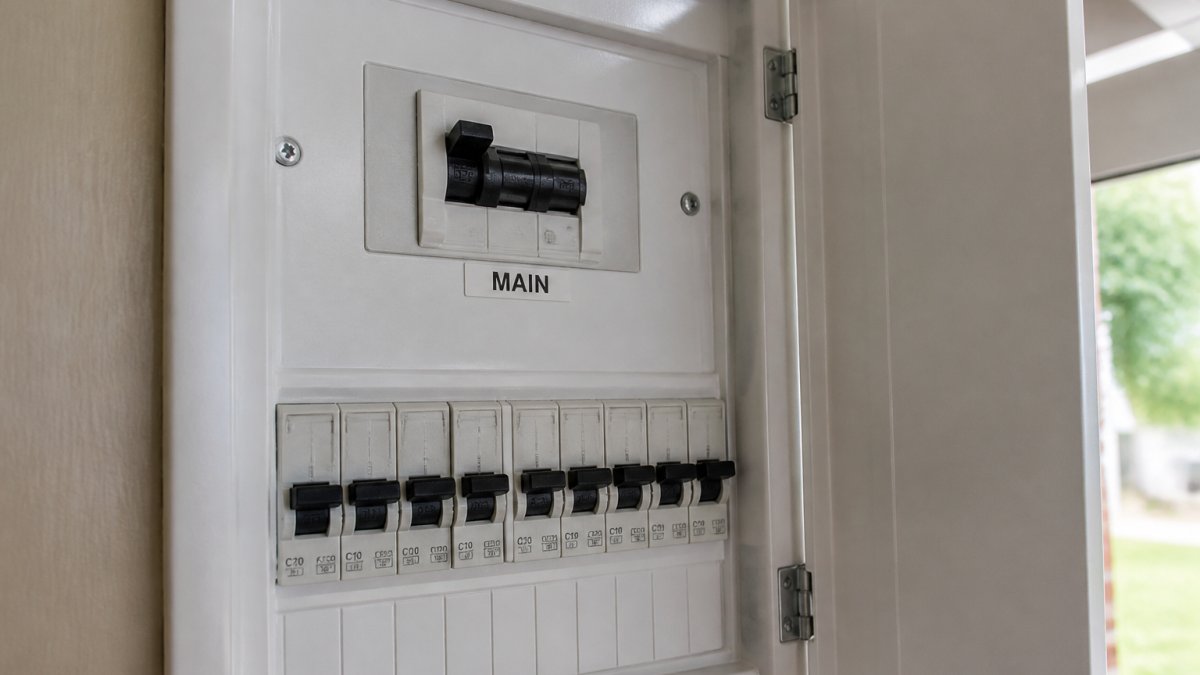
The main switch will have a label. Most boards mark it as "MAIN" or "MAINS". If the label is missing or unclear, it's the one controlling the most circuits.
Individual circuit switches sit below the main switch. These control specific circuits: kitchen, bedrooms, bathrooms, outdoor areas.
Safety switches (also called RCDs or residual current devices) look similar to circuit switches but serve a different purpose. They protect you from electrical shocks.
Switch Position: Does It Go Up or Down?
The short answer is that there is no universal up-or-down rule for main switches in Australia. Orientation depends on the switchboard design, the device manufacturer, and how the board was installed. What is reliable is the ON/OFF marking on or beside the switch, not the direction alone.
Why orientation varies
Main switches are manufactured in different configurations. Some are designed so that the toggle sits up for ON and down for OFF. Others are installed upside down relative to the board layout, or use a rotary or rocker mechanism where position is less intuitive. Older boards, in particular, may not follow the pattern you expect. This is why electricians read the markings rather than assume.
How to read the markings safely
Before you touch anything, look for:
- ON and OFF text printed on the switch or the board beside it
- I and O symbols, I (or 1) generally means ON, O (or 0) means OFF
- Colour indicators, some devices show red for ON and green for OFF, but this is not universal
- A line diagram on the inside of the board door, which often shows the correct position for each switch
If the marking is worn, painted over, or missing, do not guess. Treat the switch as unknown and have it labelled by a licensed electrician.
What to do if the position or labels are unclear
- Do not flip switches to test. Guessing can interrupt power to medical equipment, security systems, or freezers without warning.
- Check the board door or surrounding label for a diagram or schedule.
- Look for the largest device, the main switch is usually the biggest switch on the board, but confirm against the label.
- If still unclear, call a licensed electrician to identify and label the main switch. This is a quick job and removes the risk of operating the wrong device.
The reliable rule
The only safe rule is: read the marking, not the direction. Once you have confirmed which position is OFF, mark it clearly (for example, with a small label) so that everyone in the household can find it in an emergency. If you cannot confirm the marking, treat the board as unsafe to operate and seek professional help.
How to Turn Off Electricity at the Switchboard
Turning off your main power is simple, but follow these steps carefully:
- Locate the main switch, It's the largest switch at the top of your board
- Check the label, Confirm the ON and OFF positions
- Flip the switch firmly, Use a decisive movement to the OFF position
- Verify power is off, Check that lights and appliances stop working
- Wait a few seconds, Let the system stabilize before proceeding
When you need to turn off power to specific areas only, use the individual circuit switches below the main switch. These control individual circuits without cutting power to the entire house.
If a circuit switch is difficult to move or feels stuck, stop immediately. Don't force it. Call a licensed electrician to inspect it. Stuck switches can indicate a problem that needs professional attention.
What Happens When You Turn Off the Main Power
Switching off the main power stops electricity flowing to your entire home. Everything that runs on mains power stops:
- Lights go out
- Appliances stop working
- Heating and cooling systems shut down
- Security systems may lose power (battery backup may remain active)
- Refrigerators and freezers stop running
This is why you should only turn off the main switch when necessary. Extended periods without power can spoil food and cause other issues.
Most people turn off the main switch for:
- Emergency situations (electrical fire, serious shock risk)
- Major electrical work or repairs
- Extended periods away from home
- Extreme weather events
Turning off individual circuit switches is better for routine maintenance. You can isolate one area without affecting the rest of your home.
Understanding RCD Switches and When They Trip
A residual current device (RCD) is a safety switch that protects you from electrical shocks. It's different from your main switch and circuit breakers.
RCDs detect dangerous electrical current leaks. When they sense a problem, they cut power instantly, usually in milliseconds.
Your switchboard may have one main RCD protecting the entire house, or multiple RCDs protecting specific circuits.
RCDs have a test button. Press it occasionally to confirm the device works. It should cut power immediately. If it doesn't, call a licensed electrician.
Why Your Main Switch Keeps Tripping
If your main switch keeps switching off on its own, something is wrong. This usually means:
- An electrical fault exists in your home
- A circuit is overloaded
- An RCD is detecting a problem
- Water or moisture is affecting the switchboard
Never ignore repeated tripping. Each time it happens, your RCD is protecting you from danger. Find the cause before you get frustrated and leave it switched on.
Start by identifying which circuit is causing the problem. Switch off individual circuits one at a time, then turn the main switch back on. When you find the problematic circuit, leave it off and call an electrician.
If the main switch trips when all circuits are off, the problem is in the switchboard itself. This requires professional inspection. How to Fix Flickering Lights: A 2026 Homeowner's Guide covers related electrical issues that may have similar causes.
Electrical Safety and When to Call a Licensed Electrician
Switchboards carry mains voltage at all times, even when switches are off. The safety limits below are not optional, they are the difference between a routine task and a serious incident.
Situations where you should not operate the switchboard
Do not touch the switchboard, and call a licensed electrician immediately, if you notice any of the following:
- Water or moisture around or inside the board, or a wet floor beneath it
- Burning smell, scorch marks, or discolouration on the board or surrounding wall
- Exposed wiring or a missing cover
- A switch that is hot to touch or feels loose
- Sparks, buzzing, or crackling from the board
- A switch that will not move or feels stuck
These can indicate a fault that may escalate to fire or shock risk. Do not attempt to reset or force anything.
Electrical emergencies
If someone has received an electric shock, or there is smoke or fire from the switchboard:
- Do not touch the person if they are still in contact with a live source.
- Turn off the main switch only if it is safe to reach and the board is not wet or damaged.
- Call 000 for fire or medical emergency.
- Call a licensed electrician once the immediate danger is controlled.
Australian standards and licensing
Electrical work in Australia must be carried out by a licensed electrician and comply with AS/NZS 3000 (the Wiring Rules). Switchboard upgrades, new circuits, and safety switch installation are regulated work. A licensed electrician will also confirm that your board meets current requirements, including RCD protection on final subcircuits.
When to call a licensed electrician
Call a licensed electrician if: Learn how to hire a licensed electrician to ensure you find a qualified professional for your needs.
- You are unsure how to operate your switchboard safely
- Switches are stuck, loose, or difficult to move
- The board is hot, discoloured, or smells of burning
- Your RCD trips repeatedly
- You need to upgrade, modify, or label your switchboard
- You are planning any work that requires the main power to be off for an extended period
Electrical safety guidance for households
Your safety is more important than saving money on repairs. Licensed work comes with expertise, insurance, and compliance with Australian standards.
Get Your Switchboard Assessed by a Professional
Your switchboard is the heart of your home's electrical system. Regular assessment keeps it working safely and efficiently.
A licensed electrician can:
- Test all switches and circuits
- Check for corrosion or damage
- Verify RCD function
- Assess whether your switchboard meets current standards
- Recommend upgrades if needed
Older switchboards may not meet modern safety requirements. Rewireable fuses, for example, are outdated and less safe than modern circuit breakers.
Benefits of Professional Electrical Inspections explains why regular professional checks matter for your home's safety and reliability.
At Auscore Integrated Services, our fully licensed team specialises in switchboard assessment and upgrades. We provide upfront quotes and transparent advice.
Your main switch is simple to operate once you understand it.
| Situation | Action | Safety Level |
|---|---|---|
| Emergency (shock or fire risk) | Turn off main switch immediately | Critical |
| Individual circuit problem | Switch off that circuit only | Safe |
| Routine maintenance | Use circuit switches, not main | Preferred |
| Unsure about switchboard | Call a licensed electrician | Essential |
| RCD keeps tripping | Stop using that circuit, call electrician | Urgent |
Frequently Asked Questions
Should the main power switch be up or down?
The main power switch position depends on your switchboard design and manufacturer labelling. Most modern switchboards have the switch UP for ON and DOWN for OFF, but always check the label on or near your main switch first. The label is more reliable than assuming a direction. If labels are missing or unclear, contact a licensed electrician to confirm the correct position before operating it.
How do I identify the main switch on my switchboard?
The main switch is typically the largest switch at the top of your switchboard, separate from smaller individual circuit switches below it. It will be clearly labelled 'Main Switch', 'Main Isolator', or 'Mains'. Some older switchboards may have a different layout, so read all labels carefully. If you cannot locate it or the labels are unclear, ask a licensed electrician to show you which switch is the main one.
What should I do if my main switch keeps tripping?
A main switch that repeatedly trips indicates an electrical fault. Turn it off and leave it off until a licensed electrician inspects it. Do not repeatedly try to turn it back on, as this can damage equipment or create a fire risk. Common causes include overloaded circuits, faulty appliances, or water damage. Contact a qualified electrician to diagnose and fix the problem safely.
Is it safe to turn off the main power switch myself?
Yes, it is safe to turn off the main power switch if you follow these steps: locate the main switch using its label, switch it to the OFF position (usually down), and wait a few seconds before switching it back on if needed. Never force the switch or operate it if it feels stuck. If the switch is difficult to move, damaged, or you are unsure which switch is the main one, contact a licensed electrician instead of forcing it.