 how-to
How to Fix Flickering Lights: A 2026 Homeowner's Guide
Table of Contents
- Safety First: When Flickering Lights Need an Electrician
- Common Causes of Flickering Lights
- Step-by-Step: How to Fix Flickering Lights
- Signs of Faulty Switchboard Wiring
- When to Upgrade Your Home Switchboard
- The Cost of Electrical Fault Finding
- Frequently Asked Questions
Last Updated: September 20, 2026
Safety First: When Flickering Lights Need an Electrician
Flickering lights are one of the most common electrical complaints in homes, and most people try to fix them before calling anyone. Flickering lights are one of the most common electrical complaints in homes, and most people try to fix them before calling anyone. A homeowner tightens a bulb, the flicker stops, and they move on. Sometimes that works. Sometimes it hides a bigger problem.
Common Causes of Flickering Lights
Flickering lights usually trace back to one of a few causes: a loose bulb, a worn socket, a dimmer that does not suit your LED globes, a loose connection behind the switch, or a problem at the switchboard itself. The tricky part is telling them apart.
Here is how to sort the likely culprits quickly:
| What You Notice | Likely Cause | Who Should Fix It |
|---|---|---|
| One light flickers, others fine | Loose bulb or worn socket | You can check this |
| Lights flicker when dimmed | Dimmer and LED mismatch | You or an electrician |
| Several lights flicker together | Loose connection or circuit issue | Licensed electrician |
| Flicker when big appliances start | Voltage drop or overloaded circuit | Licensed electrician |
| Flicker across the whole home | Switchboard or supply issue | Licensed electrician |
Loose Bulbs and Faulty Connections
A loose bulb is the most common and easiest cause. Heat cycles from normal use can slowly loosen a globe in its socket. The contact becomes intermittent, and the light flickers.
Dimmer Switch and LED Compatibility
Not all dimmers work with all LED globes. Older dimmers were built for halogen and incandescent bulbs, which draw power differently. LEDs need a compatible dimmer and often a suitable LED driver.
Step-by-Step: How to Fix Flickering Lights
You can safely rule out the simple causes yourself. Anything involving wiring, the switchboard, or a fitting you cannot reach should go to a licensed electrician.
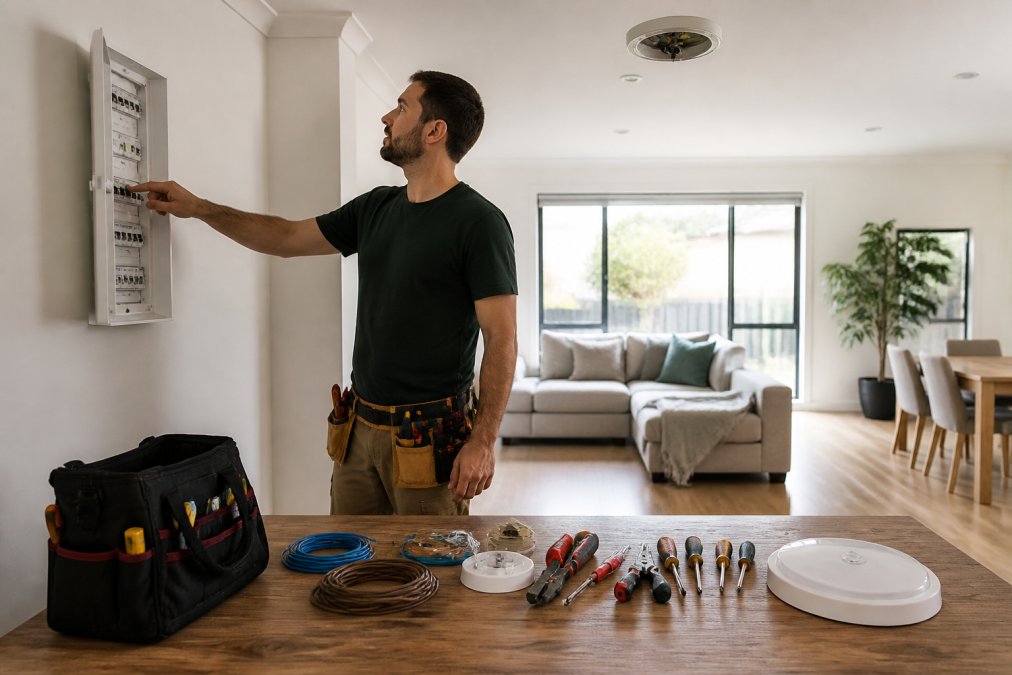
Here are the checks to run, in order.
Step 1: Tighten the Bulb and Check the Socket
Turn the light off at the wall first. Let the globe cool, then remove it and look at the socket.
- Check the bulb base for dark marks or corrosion
- Look for bent or flattened contact points inside the socket
- Screw the globe back in firmly, but do not overtighten
- Test the light
Step 2: Test the Dimmer Switch and LED Driver
If the flicker only happens when dimmed, the dimmer is the likely cause. Turn the dimmer to full brightness. If the flicker stops at full power, the dimmer and globe are mismatched.
Signs of Faulty Switchboard Wiring
Switchboard wiring problems show up as flickering across multiple lights, not just one. That is your first clue that the issue is upstream of the fitting, the fault sits between the supply and the circuit, so every light on that circuit inherits it.
- Voltage drop under load. When a high-draw appliance starts, it pulls current through shared wiring. If a connection has resistance, a loose terminal, a corroded lug, an undersized cable, the voltage at the lights sags momentarily and they dim or flicker. This is why the flicker is often tied to the oven, air-conditioner, dryer, or a welder in the shed.
- Arcing at a loose connection. A terminal that is not tight enough creates a tiny gap. Current jumps the gap, heats the metal, and the contact becomes intermittent. You may hear a faint crackle or buzz at the switch or switchboard, and the flicker is erratic rather than rhythmic.
- Neutral or earth fault. A degraded neutral or a poor earth path can cause lights to flicker, brighten unexpectedly, or pulse across the whole home. This is the most serious pattern and should be treated as an emergency.
- Overloaded circuit. Too many loads on one circuit cause a steady dimming that worsens as more appliances run, rather than a sharp flicker.
Watch for these signs:
- Lights dim or flicker when the oven, air-conditioner, or dryer starts
- The flicker affects several rooms at once
- Breakers trip without an obvious reason
- A burning smell near the switchboard
- Warm or discoloured power points and switches
- Lights that brighten when a large appliance switches off
Appliance Interference and Voltage Drop
A common pattern that gets misdiagnosed is flicker that only appears when a specific appliance runs. Large motor loads, air-conditioners, dryers, fridges, pool pumps, and welders, draw a surge of current at start-up. On a healthy circuit the voltage dip is too small to see. On a circuit with a marginal connection or undersized cable, the dip is visible as a flicker.
Smart Bulbs, Hubs, and Modern Lighting
A newer cause that most guides skip is smart lighting. Smart globes and hubs can flicker for reasons that have nothing to do with your wiring:
- Firmware or driver issues. A smart globe with outdated firmware may flicker or strobe, especially after a power interruption. Check the manufacturer's app for updates before assuming a wiring fault.
- Wi-Fi or Zigbee interference. A hub placed too close to a router, microwave, or metal switchboard can drop commands, causing the globe to pulse as it reconnects.
- Incompatible dimmers. Many smart globes are not designed to sit behind a wall dimmer. If the dimmer is left in a partially dimmed position, the globe may flicker even when the smart app says it is at full brightness.
- Neutral-required switches. Some smart switches need a neutral wire at the wall box. Without it, they can flicker or fail to hold state.
When to Upgrade Your Home Switchboard
An upgrade is worth considering when your switchboard cannot safely carry the load your home now demands. Older boards were built for far fewer circuits than a modern home uses.
Signs it may be time to upgrade:
- You have added solar, an EV charger, or a large air-conditioning system
- The board still uses old ceramic fuses instead of circuit breakers
- You keep adding double adaptors because there are too few power points
- Your electrician has flagged safety switches are missing
The Cost of Electrical Fault Finding
The cost of electrical fault finding depends on how hard the fault is to locate. Simple issues like a loose bulb take minutes. Intermittent faults that only show up under certain loads can take much longer to trace, because the electrician has to reproduce the fault before they can fix it.
- Call-out fee plus hourly rate. The most common model. You pay a set attendance fee, then an hourly rate for time on site. The call-out fee covers travel and the first portion of time.
- Fixed fee for the first hour, then hourly. Some businesses quote a flat amount for the first hour of diagnosis, then bill additional time at an hourly rate.
- Quote for the repair, not the diagnosis. Less common for intermittent faults, because the electrician cannot know the repair until they find the cause.
What drives the cost up:
- Intermittent faults. If the flicker only happens when the oven, air-conditioner, or dryer runs, the electrician may need to run those appliances while testing. That takes time.
- Access. A fault behind a plaster ceiling, under a tiled floor, or inside a wall cavity takes longer to reach than one at a switchboard or a visible junction box.
- Multiple circuits. If the flicker affects several circuits, each one has to be isolated and tested.
- Age of wiring. Older homes with rubber-insulated cable or ceramic fuses often need more careful testing and may reveal additional issues once the fault is opened up.
What keeps the cost down:
- A clear pattern. If you can tell the electrician exactly when the flicker happens, which appliances are running, and whether it is one light or several, they can often go straight to the likely cause.
- Photos or video. A short phone video of the flicker, including the sound if there is a buzz or crackle, can save diagnostic time.
- A written history. Note the date the flicker started, any recent electrical work, and any changes to appliances or lighting.
Frequently Asked Questions
Do flickering lights indicate a serious electrical problem?
They can. While a loose bulb is a simple fix, flickering across multiple rooms often points to a loose connection, voltage fluctuation, or a failing switchboard. If your lights dim when appliances turn on, or if you notice a burning smell, turn off the circuit and call a licensed electrician immediately. Persistent flickering is a sign of an electrical fault that needs professional testing.
Can flickering LED lights be repaired or do they need replacement?
It depends on the cause. If the issue is an incompatible dimmer switch or a faulty LED driver, an electrician can often replace the driver or dimmer to fix it. If the LED chip itself is failing, the fitting usually needs replacement. Because LED drivers are sensitive to voltage drop and ripple signals, testing the circuit is the only way to know if a repair or a full replacement is required.
Why do my lights flicker even when the switch is off?
Flickering when the switch is off usually means the fixture is receiving a small amount of current. This can happen with smart switches that leak current, or when a neutral wire is shared incorrectly. It is also common with LED bulbs that have a driver sensitive to residual voltage. An electrician can test the wiring integrity and install a bypass or correct the circuit to stop the strobe effect.
Is it worth upgrading my switchboard to fix flickering lights?
If your switchboard is old, has ceramic fuses, or is overloaded, an upgrade is often the permanent fix. Modern switchboards handle the load capacity of today's appliances and LED lighting without voltage drop. When you upgrade, you also get safety switches for each circuit. The cost of electrical fault finding is often absorbed into the upgrade, making it a cost-effective long-term solution.
Flickering lights are rarely just an annoyance. They are your home telling you something needs attention, whether that is a loose globe or wiring that has quietly worn out. If you have checked the bulb and the flicker keeps coming back, it is time to get it looked at properly. Auscore Integrated Services provides licensed electrical fault finding, switchboard upgrades, and safety checks, backed by upfront pricing and a workmanship guarantee. Book now and get your lighting sorted safely.