 ultimate-guide
Cost of EV Charger Installation: A 2026 Pricing Guide
Table of Contents
- What Drives the Cost of EV Charger Installation
- EV Charger Installation Requirements for Your Home
- Home EV Charger Switchboard Upgrade Cost Explained
- Smart EV Charger Benefits That Justify the Spend
- Rebates and Incentives That Lower Your Upfront Cost
- Strata and Apartment Installation Challenges
- Conclusion
- Frequently Asked Questions
Last Updated: September 17, 2026
What Drives the Cost of EV Charger Installation
The cost of EV charger installation is not a single line item. It is a bundle of hardware, labour, and electrical work that changes with your home's existing wiring. This guide from Auscore Integrated Services breaks down each component so you can read a quote with confidence.
Two forces set the price: what you buy, and what your switchboard can safely support.
Hardware and Installation Labour
Hardware is the predictable part. A wallbox unit, mounting bracket, and cabling form the base of most quotes.
Labour is where prices separate. A straightforward garage install with a nearby power source takes far less time than a run from the front of the house to a detached carport. Conduit installation, cable length, and wall penetrations all add hours.
The Australian Building Codes Board maintains the standards that govern electrical work in homes. Compliance is not optional, and it is not free.
Most installers quote hardware and installation labour separately so you can see where the money goes. Ask for that split.
EV Charger Installation Requirements for Your Home
Home EV charger installation requirements come down to three things: power supply, protection devices, and physical placement. Get these wrong and the job fails inspection.
Power Supply and Switchboard Capacity
A dedicated circuit is mandatory. The charger cannot share a general-purpose circuit with your oven or air-conditioning.
Your switchboard needs capacity for the new load. Older boards often run close to their limit, especially in homes with solar, ducted air, and a pool pump already drawing power.
Voltage requirements and power capacity determine whether a single-phase supply is enough or whether three-phase is the better path. A licensed electrician assesses this on site, not over the phone.
Home EV Charger Switchboard Upgrade Cost Explained
A switchboard upgrade is frequently the largest single line in a home EV charger switchboard upgrade cost. It covers a new board, circuit breakers, RCD protection, and the labour to rewire existing circuits safely.
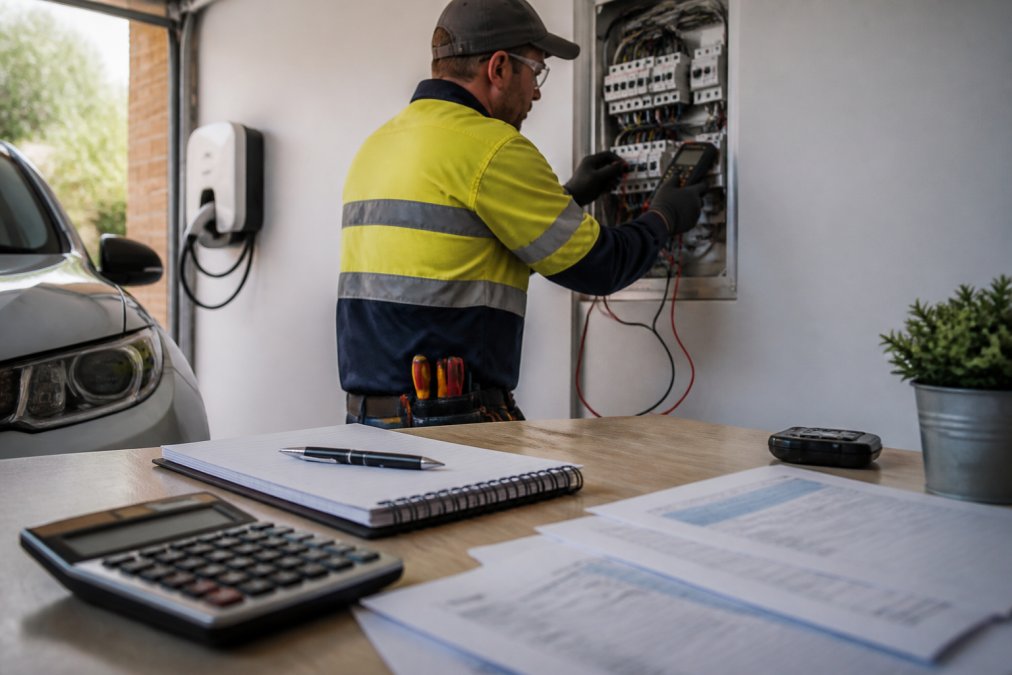
Not every home needs one. A modern board with spare capacity and compliant protection devices may only need a new circuit added. An older fuse box almost always needs replacement.
What Actually Drives the Upgrade Price
Four variables separate a minor job from a major one:
- Board age and type. Ceramic fuses and outdated boards require full replacement rather than a simple circuit addition.
- Available space. Tight switchboards need reorganisation before new circuits fit, and that reorganisation is billed as labour, not parts.
- Compliance gaps. Missing RCD protection must be corrected before the charger is connected, and correcting it can mean rewiring multiple existing circuits.
- Cable run from board to charger. This is the variable most often underestimated. A charger mounted on the same wall as the board is a short job; a run to a detached carport or a far corner of a double garage can add significant cable, conduit, and time.
How to Read a Switchboard Quote
A transparent quote separates three things: the board and protection hardware, the new dedicated circuit, and any remediation of existing circuits. If a quote bundles all three into one figure, ask for the split. The split tells you whether you are paying for a genuine upgrade or for a simple circuit addition dressed up as one.
A common pattern is for the upgrade to be quoted as a fixed allowance, with cable runs charged per metre beyond a stated distance. Ask what that distance is and where it is measured from. The answer changes the final figure more than the board itself.
When You Can Avoid the Upgrade
If your board is modern, has spare ways, and already has compliant RCD protection on the circuits that matter, the electrician may be able to add a dedicated circuit without replacing the board. This is the cheapest outcome and worth asking about directly. Do not assume an upgrade is required just because a quote includes one.
The Safety Obligation Behind the Cost
The SafeWork Australia electrical safety guidance outlines the safety obligations that apply to electrical work. A compliant upgrade protects the installation and the people using it. That compliance work is a real cost, not padding, and it is the part of the quote you should be least willing to cut.
Treat the switchboard line as two questions: does the board need replacing, and how far is the cable run? Get a clear answer to both before you compare quotes.
Smart EV Charger Benefits That Justify the Spend
Smart EV charger benefits extend well beyond convenience. A connected charger lets you schedule charging, monitor usage, and shift load to off-peak windows.
That scheduling matters. Peak demand charges and time-of-use tariffs reward households that charge overnight. A smart unit automates this without you thinking about it.
Smart charging also supports load management. The charger communicates with your home's supply and reduces draw when other appliances are running, which can avoid a costly supply upgrade.
Solar-integrated charging setup is the other drawcard. Pairing a smart charger with rooftop solar lets you charge from excess generation rather than the grid.
Rebates and Incentives That Lower Your Upfront Cost
Rebate eligibility varies by state and by scheme, and it changes. Rather than quote figures that may be out of date, check the current offers directly.
Rebates are usually claimed after installation, not deducted upfront. Budget for the full amount and treat the rebate as a later recovery, not a discount at the counter.
Strata and Apartment Installation Challenges
Strata and apartment installations run into problems that standalone homes never face. The building's electrical infrastructure is shared, and that changes everything. Most guides written for detached homes skip this entirely, which leaves apartment owners and strata committees without a realistic cost picture.
Why the Cost Profile Is Different
In a standalone home, the charger connects to your own board on your own meter. In a strata building, one or more of those assumptions usually breaks:
- Shared switchboards. Your parking bay may draw from common property supply rather than your own meter, which means the cost cannot be scoped without knowing who owns the supply point.
- Body corporate approval. Written consent is typically required before any work on common property, and the approval process itself can add weeks to the timeline.
- Cable routes. Running cable from a basement board to a distant bay can be the single biggest cost driver, and in some buildings the route is not viable at all without trenching or new risers.
- Load capacity. One charger is manageable. Ten chargers on the same supply need a coordinated plan, and that plan has to be paid for by someone.
The Approval Pathway
The practical sequence is: confirm who owns the supply point, obtain body corporate consent in writing, commission a load study, then scope the cable route. Skipping the load study is the most expensive shortcut in strata work, because it is the step that reveals whether the building can support the chargers at all.
Staged Rollouts and Cost Sharing
For strata managers, the smart approach is a staged rollout with a load study first. Installing chargers one at a time without a capacity plan leads to expensive rework, because each new charger erodes the headroom the next one needs.
- Individual owner pays for their own charger and circuit, with the building covering any common-property infrastructure.
- Shared infrastructure, individual chargers. The building funds the backbone, supply capacity, cable routes, load management, and owners fund their own units.
- Whole-building solution. The body corporate installs shared chargers and recovers cost through levies or usage fees.
Load Management as a Cost Avoidance Tool
Smart load management hardware can let a building add chargers without a full supply upgrade, by capping total draw and sharing capacity across bays. The hardware costs money, but it is frequently cheaper than the alternative: a supply upgrade to the building's main incoming supply. This is the single most useful lever a strata committee has, and it is worth asking an electrician to model both options before committing.
Get the load study before you get quotes for the chargers. Quotes written without it are estimates at best, and in a strata building they are often wrong in the expensive direction.
Conclusion
The real challenge with EV charger pricing is that no two homes are the same, and a quote that ignores your switchboard is a quote you cannot trust. Auscore Integrated Services handles the full scope in-house: switchboard upgrades, dedicated circuit installation, and smart charger setup, all completed by fully licensed and insured tradespeople with upfront quotes and a workmanship guarantee.
Frequently Asked Questions
Does my home switchboard need an upgrade for an EV charger?
It depends on your current power capacity. Many older homes have switchboards that cannot handle the additional load of a 7kW or 22kW charger. A licensed electrician will check your board during a site assessment. If your switchboard lacks spare capacity or RCD protection, an upgrade is required for electrical compliance and safety.
Are there government rebates available for EV charger installation?
Rebate eligibility varies by state and program. Some states offer incentives for smart chargers or off-peak charging setups. Check current government programs before you book, as funding is limited and criteria change. Your installer can confirm which rebates apply to your situation and help you meet the requirements.
What is the difference between a 7kW and 22kW charger installation cost?
A 22kW charger costs more to install because it usually requires three-phase power. Most homes have single-phase supply, so a 22kW unit may need a switchboard upgrade and new cabling. A 7kW charger runs on single-phase and suits overnight charging for most drivers. The hardware price difference is smaller than the electrical work difference.
How long does a professional EV charger installation take?
A standard single-phase installation takes 2 to 4 hours if your switchboard has capacity and the cable run is short. If a switchboard upgrade or long conduit installation is needed, it can take a full day. Strata or apartment installations take longer due to approvals and shared infrastructure. Your installer will give a time estimate with the quote.