 blog
blog
Emergency Electrical Repair Services: 24/7 Perth Guide
Table of Contents
- When to Call for Emergency Electrical Repair
- Common Electrical Emergencies and What They Mean
- 24 Hour Electrician Call Out Fee: What to Expect
- Urgent Electrical Safety Checks Before Help Arrives
- Electrical Fault Finding Services: How Professionals Diagnose Problems
- Why Licensed Contractors Matter for Emergency Work
- Preventative Maintenance to Avoid Future Emergencies
- Frequently Asked Questions
Last Updated: September 23, 2026
When to Call for Emergency Electrical Repair
An emergency electrical repair isn't always obvious. The key is recognising what warrants an urgent call versus what can wait until business hours.
Electrical emergencies pose immediate risk: a tripping safety switch, burning smell, or complete power loss. These aren't problems to troubleshoot yourself or postpone.
Acting quickly when you notice warning signs avoids far costlier damage. Hesitation often turns a simple fault into a full rewiring job.
Buzzing from outlets, scorch marks around power points, or persistent flickering are signals to call for professional assessment immediately.
Common Electrical Emergencies and What They Mean
Electrical problems manifest as physical symptoms: sparks, smells, sounds, or sudden loss of power. Understanding each symptom helps you decide whether to evacuate or wait safely for help.
Safety Switches and RCD Faults
A safety switch (RCD) cuts power instantly if it detects a fault. Repeated trips signal an underlying problem needing professional diagnosis.
If your safety switch won't reset or trips immediately when flipped back, don't keep resetting it, this masks a deeper issue that could lead to electrocution or fire risk.
Common causes include water damage, faulty appliances, or deteriorated insulation. Fault finding isolates which circuit or appliance is triggering the fault; the fix usually involves replacing the faulty component or repairing wiring.
Power Outages and Switchboard Issues
A complete power loss is different from a tripped circuit. If everything goes dark, the fault is likely at your switchboard or main supply.
Switchboard problems range from tripped main switches to equipment failure. Immediate diagnosis is critical, without power, you lose heating, cooling, refrigeration, and security systems.
Contact your network provider to confirm the outage isn't area-wide. If neighbours have power and you don't, call for urgent electrical repair service.
Burning Smells and Exposed Wiring
A burning smell from electrical fixtures indicates insulation failure, overheating, or arcing, always warrants immediate action.
Exposed wiring is equally serious. If you see bare copper or damaged insulation, treat it as a hazard and call for professional assessment.
24 Hour Electrician Call Out Fee: What to Expect
After-hours emergencies cost more, and pricing uncertainty often delays necessary calls. Understanding how charges are structured helps you decide whether to wait or call immediately.
HOW EMERGENCY ELECTRICAL CHARGES ARE STRUCTURED:
Your total invoice typically has three separate components:
-
Call-out fee (after-hours surcharge). A fixed charge for availability outside standard business hours (typically 5 p.m. to 8 a.m. weekdays, all day weekends). This applies regardless of job duration or whether parts need ordering. It's the cost of immediate availability, charged as a separate line item.
-
Labour charges. Time spent diagnosing and repairing, typically hourly or fixed-price once the problem is identified. A tripped safety switch might take 15 minutes; a switchboard fault could take 2-3 hours.
-
Parts and materials. You pay the cost of replacement components (circuit breaker, safety switch, power point, wiring) plus a small markup for supply.
WHAT AFFECTS YOUR TOTAL COST:
- Complexity of diagnosis. Visible faults cost less to diagnose than hidden faults requiring systematic testing.
- Parts in stock. In-stock parts enable immediate repair; ordered parts require a second visit.
- Location. Remote areas may incur travel charges.
- Time of call. After-hours surcharges vary by time band.
- Scope creep. Larger issues discovered during diagnosis require a revised quote before proceeding.
REALISTIC COST RANGES (for context, not a quote):
- Simple resets: call-out fee + 15-30 minutes labour.
- Single-component replacement: call-out fee + 30-60 minutes labour + parts cost.
- Fault-finding for hidden problems: call-out fee + 1-2 hours diagnostic labour. May require a second visit if parts need ordering.
- Switchboard repairs: call-out fee + 2-4 hours labour + parts cost.
HOW TO REDUCE COSTS:
-
Call during business hours if not life-threatening. A fault you can safely isolate costs significantly less than an after-hours call.
-
Have information ready. Describe exactly what you've observed (burning smell, tripping, sparking, power loss areas). Faster diagnosis = lower labour cost.
-
Ask for a fixed quote. Once the fault is identified, request a fixed price rather than hourly rate.
-
Invest in preventative maintenance. Annual switchboard inspection costs far less than emergency call-out and prevents costly repairs.
TRANSPARENCY AND INSURANCE:
A reputable licensed electrician provides an itemised invoice showing call-out fee, labour, parts, and travel charges separately. Licensed electricians carry public liability and professional indemnity insurance; unlicensed operators leave you unprotected if damage occurs.
THE REAL COST OF DELAY:
Many homeowners hesitate to call because they're worried about the after-hours surcharge. The reality is that delaying an emergency repair almost always costs far more. A small electrical fault left unattended overnight can escalate into switchboard damage, wiring replacement, or even structural fire damage.
Urgent Electrical Safety Checks Before Help Arrives
While waiting for your electrician, a structured safety triage approach helps you assess severity, protect your property, and communicate the urgency accurately. Most homeowners don't know whether to evacuate, isolate power, or simply wait, this framework removes that guesswork.
IMMEDIATE EVACUATION REQUIRED (Call 000 first, then your electrician):
If any of these are present, leave the building immediately:
- Active sparking, arcing, or visible flame from electrical equipment or wiring
- Strong burning smell accompanied by smoke or visible heat distortion
- Electrical equipment that is hot to the touch (not warm, but genuinely hot)
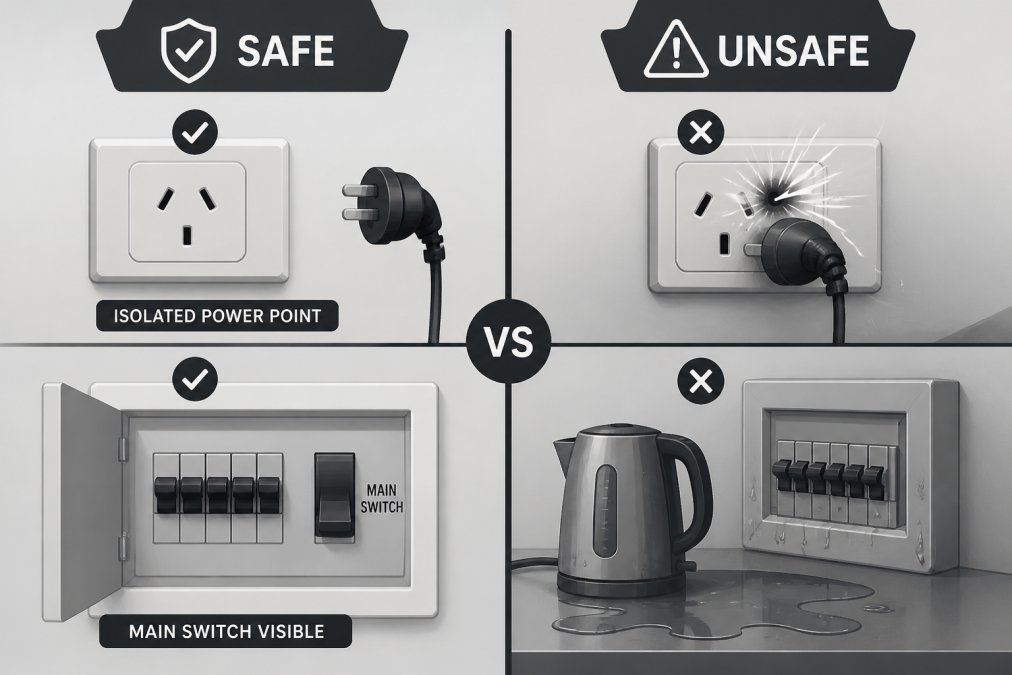
- Water actively dripping onto or pooling around electrical switchboards, power points, or appliances
- Tingling or electric shock sensation when touching metal fixtures, door frames, or plumbing
If you observe these, isolate the affected area and wait for professional help:
- Safety switch (RCD) tripping repeatedly, especially when you try to reset it
- Burning smell coming from a specific power point, light fitting, or appliance (but no visible flame or smoke)
- Scorch marks, discolouration, or melting around power points or switches
- Buzzing or crackling sound from the switchboard or walls
- One or more circuits completely dead (no power to outlets or lights in that area)
- Flickering lights that persist across multiple rooms or don't stop when you turn off appliances
If the problem is limited to:
- A single power point that won't accept a plug or feels loose
- One light fitting that won't turn on (but others work fine)
- A single appliance that won't power on (the appliance itself may be faulty, not your wiring)
SAFE ACTIONS WHILE WAITING:
-
Locate and understand your switchboard. Know where your main switch is and how to turn off power to individual circuits. If you smell burning or see sparks, switch off the main power immediately. This single action prevents most electrical fires.
-
Isolate the problem area. Don't use outlets, switches, or appliances in the affected zone. If a power point is warm, discoloured, or sparking, mark it as unsafe and avoid it entirely.
-
Keep water away from electrical equipment. If you have wet areas near your switchboard, power points, or damaged wiring (from a leak, flood, or condensation), dry the area if it's safe. Do not use electrical equipment in or near wet spaces.
-
Document your observations. Note the time the problem started, exactly what you saw or heard (burning smell, sparking, tripping, etc.), which circuits or appliances are affected, and what you've already tried. This information helps your electrician diagnose the fault faster and can reduce diagnostic time, potentially lowering your bill.
-
Photograph or video the fault if safe. If you can safely capture a photo of scorch marks, a tripped switchboard, or a discoloured outlet without touching anything, send it to your electrician when you call. Visual evidence speeds up diagnosis.
Electrical Fault Finding Services: How Professionals Diagnose Problems
When an electrician arrives for your emergency electrical repair, they don't guess. They use systematic fault finding to isolate the problem, confirm the root cause, and plan the correct fix.
Why Licensed Contractors Matter for Emergency Work
When electricity is involved, licensing isn't a preference, it's a legal and safety requirement. A licensed electrician has completed formal training, passed rigorous exams, and maintains ongoing professional standards.
Preventative Maintenance to Avoid Future Emergencies
The best emergency electrical repair is the one you never need. Regular maintenance catches small problems before they become crises.
Preventative maintenance includes:
- Annual switchboard inspection: Early detection prevents sudden failure.
- Safety switch testing: Monthly testing confirms RCD protection.
- Power point inspection: Warm outlets or discolouration indicate failing components.
- Appliance cord checks: Replace cords with visible damage.
- Lighting circuit testing: Persistent flickering suggests wiring issues.
- Water-exposed areas: Kitchens, bathrooms, and laundries need RCD-protected circuits.
Frequently Asked Questions
When should I call an emergency electrician versus waiting until morning?
Call immediately if you see burning smells, exposed wiring, flickering lights that won't stop, or a safety switch that keeps tripping. These indicate electrical hazards that pose fire or shock risks. If power is simply out and your home is safe, you can often wait. However, if you're unsure whether the problem is dangerous, calling for urgent electrical safety checks is the safer choice. A licensed contractor can assess the risk quickly.
What does a 24 hour electrician call out fee typically cover?
Call-out fees vary based on the time of day, distance, and complexity of the emergency electrical repair. Most after-hours fees cover the electrician's travel time and initial diagnostic work to identify the fault. However, the cost of parts, labour for repairs, and switchboard upgrades are usually separate. Contact Auscore Integrated Services for an upfront quote, we provide transparent pricing so you know what to expect before work begins.
How do I identify a genuine emergency electrician?
Look for a licensed contractor with a current electrical contractor number. In Western Australia, verify their credentials through the relevant licensing body. Ask about their experience with fault finding and whether they offer same-day service. Reputable providers like Auscore Integrated Services are fully insured, offer workmanship guarantees, and can provide customer references. Avoid anyone who won't give you an upfront quote or refuses to identify themselves with a license number.
What safety steps should I take before an emergency electrician arrives?
Turn off the main power switch if you suspect a serious fault, but only if you can do so safely. Keep people and pets away from the affected area. Do not touch exposed wiring, wet switches, or areas with burning smells. If there's a fire risk, evacuate and call emergency services. Document what happened, flickering lights, tripped switches, or unusual sounds, so you can describe it to the licensed contractor. This information helps with rapid fault finding and diagnosis.