 how-to
Why Is My Air Conditioner Blowing Warm Air? 2026 Guide
Table of Contents
- Quick Checks Before You Panic
- Common Reasons Your Air Conditioner Is Blowing Warm Air
- How to Clean Air Conditioner Filters
- Signs Your Air Conditioner Needs Regassing
- When to Call an Air Conditioning Technician
- Seasonal Maintenance Checklist
- Frequently Asked Questions
Last Updated: September 14, 2026
Quick Checks Before You Panic
An air conditioner blowing warm air is usually either a setting you can fix in thirty seconds or a component that needs a licensed technician. Knowing which saves you a call-out fee or a week of sweating while you wait for a part.
Our Perth-based team attends air-conditioning faults across the metro area, and a surprising share of "broken" systems turn out to be a thermostat in the wrong mode or an untouched filter. This guide covers the eight faults behind most warm-air complaints, how to clean filters, the warning signs your system needs regassing, and where DIY stops being sensible.
Before you book anyone, run these checks:
- Confirm the thermostat is set to COOL, not FAN or HEAT, and that the setpoint is below the current room temperature.
- Check the indoor unit is actually running. If the outdoor condenser unit is silent, you have a power or control fault, not a cooling fault.
- Look at the air filter. A clogged filter restricts airflow and can make the coil freeze, which produces warm air at the vents.
- Check the circuit breaker for the air-conditioning circuit. A tripped breaker means the compressor never started.
- Wait ten minutes. Some systems run a delay before the compressor engages, and short-cycling can look like a fault when it isn't.
If those five checks come back clean and the air is still warm, work through the fault list below in order. It runs from the cheapest fix to the most expensive.
Common Reasons Your Air Conditioner Is Blowing Warm Air
Most warm-air faults trace back to one of eight causes: a dirty filter, thermostat settings or malfunction, low refrigerant, a refrigerant leak, electrical or power supply problems, compressor failure, dirty condenser coils, or a failing blower motor. The first two you can usually fix yourself. The rest need a licensed technician with the right gauges and test equipment.
Here's the diagnostic sequence professionals follow:
| Symptom | Likely Cause | DIY or Technician |
|---|---|---|
| Weak airflow, warm vents | Clogged air filter | DIY |
| Indoor unit off, outdoor unit silent | Thermostat or circuit breaker | DIY check, then technician |
| Ice on indoor unit, warm air after thaw | Frozen evaporator coil from airflow restriction | Technician |
| Hissing or bubbling at outdoor unit | Refrigerant leak | Technician |
| Outdoor unit hums but won't start | Capacitor or compressor fault | Technician |
| Warm air only in some rooms | Ductwork leak or blocked vent | Technician |
| Outdoor unit runs constantly, no cooling | Dirty condenser coils | DIY clean, technician if persistent |
| Air moves but isn't cold | Blower motor or refrigerant charge | Technician |
Dirty or Clogged Air Filters
A clogged air filter is the single most common cause of an air conditioner blowing warm air, and the one most homeowners can fix in five minutes. When the filter loads up with dust, the evaporator coil can't pull enough air across it, the coil drops below freezing, ice forms, and the system stops transferring heat out of your home. You feel warm air because there's barely any air moving at all.
Replace or clean disposable filters every one to three months, and more often if you have pets or live near construction. If the filter looks grey and matted when you hold it to the light, it's overdue.
Thermostat Settings and Malfunctions
Check the thermostat before anything else. A system set to FAN instead of COOL circulates room-temperature air all day, which feels warm against your skin, as will a setpoint above the actual room temperature or a schedule still in "away" mode.
Thermostats also fail. A faulty temperature sensor reads the room as cooler than it is, so the compressor never engages. If your thermostat display is blank, flickering, or showing a temperature that doesn't match a separate thermometer, that's your problem.
Low Refrigerant Levels and Refrigerant Leaks
Refrigerant moves heat from inside your home to the outdoor unit. If the charge is low, the system can't absorb enough heat and the air at your vents stays warm even though the unit runs.
Low refrigerant almost always means a leak, because a sealed system doesn't consume refrigerant over time. A technician will use leak detection equipment to find the breach, repair it, then pressure-test and recharge the system. Topping up the gas without fixing the leak just delays the same fault by a few months.
Electrical Issues and Power Supply
The compressor draws a heavy current, so it runs on its own circuit and breaker. A tripped breaker, blown fuse, or loose connection at the isolator stops the compressor while leaving the indoor fan running. Air moving but not cold points straight at the electrical side.
A failing capacitor is another common culprit. The capacitor gives the compressor motor the initial jolt it needs to start. When it weakens, the outdoor unit hums, trips, and restarts, or refuses to start at all.
Compressor Failure
The compressor is the heart of the system, and when it fails, no amount of cleaning or regassing brings the cold back. Warning signs include loud clunking or grinding, the outdoor unit tripping the breaker repeatedly, or a compressor that runs hot and never produces cold refrigerant lines.
Compressor replacement is a significant repair. On an older system, it's often worth comparing the repair cost against a new, more efficient unit before committing.
Dirty Condenser Coils
The condenser coil sits in the outdoor unit and releases the heat collected indoors. Coated in dust, grass clippings, or lint, it can't shed that heat, so the cooling cycle becomes inefficient: the system runs longer, the air gets warmer, and your power bill climbs.
Clean the coils every six to twelve months. Turn the power off at the isolator first, then rinse the coil fins from the inside out with a garden hose on a gentle setting.
Blower Motor Problems
The blower motor pushes conditioned air through your ductwork. A failing motor delivers weak airflow, and weak airflow from a cold coil feels warm by the time it reaches the room. You may also hear rattling, squealing, or a motor that starts and stops.
Blower motors fail gradually. If airflow has been dropping for weeks, get it checked before the motor seizes entirely.
How to Clean Air Conditioner Filters
Cleaning your air conditioner filters takes about ten minutes and is the highest-value maintenance task you can do yourself. Clean filters maintain airflow, prevent frozen coils, and keep the system running at its designed efficiency.
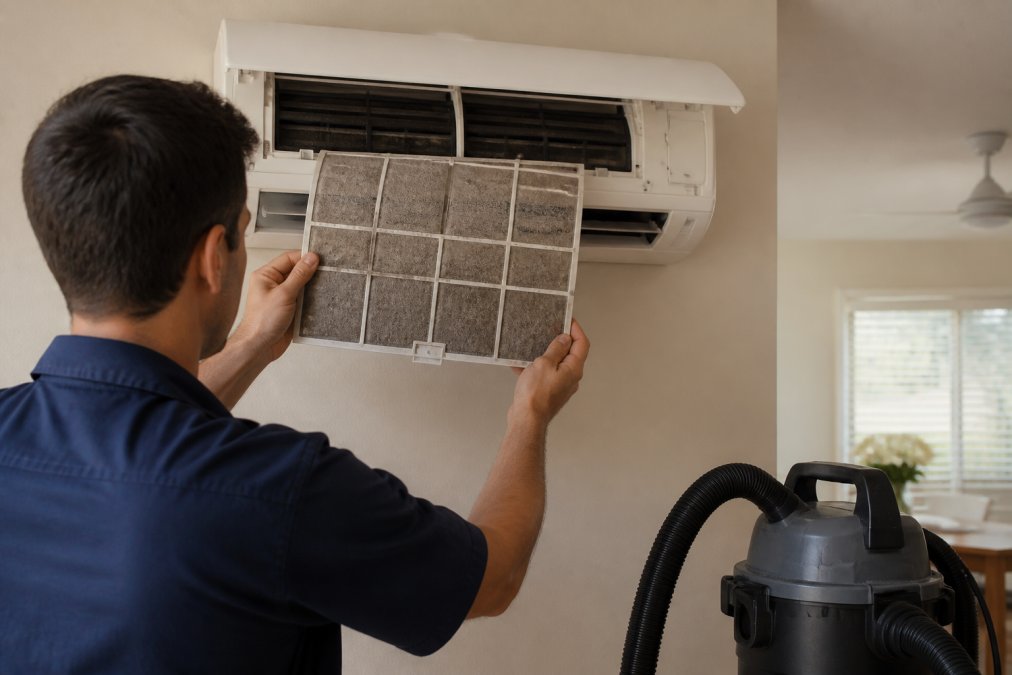
For a reusable filter:
- Turn the system off at the thermostat and the isolator.
- Open the indoor unit's front panel and slide the filter out.
- Vacuum both sides with a soft brush attachment to lift loose dust.
- Rinse under lukewarm water, working from the clean side to the dirty side.
- Let it dry completely in the shade. Never refit a damp filter.
- Refit, close the panel, and restore power.
Disposable filters get replaced, not washed. Check the filter size printed on the frame and keep a spare on hand so you're never tempted to refit a dirty one.
Signs Your Air Conditioner Needs Regassing
Your air conditioner needs regassing when the refrigerant charge has dropped, which almost always points to a leak. Regassing is not routine maintenance, and a system needing it every year has an unresolved fault.
Watch for these signs:
- Ice on the indoor unit or refrigerant lines. Low pressure causes the coil to freeze.
- Hissing or bubbling sounds near the outdoor unit, which can indicate escaping refrigerant.
- Longer run times with the system never quite reaching the setpoint.
- Weak cooling that gets progressively worse over weeks rather than failing all at once.
- Higher power bills as the compressor works harder for less result.
A licensed technician will confirm the diagnosis with pressure gauges and electronic leak detection, repair the leak, then evacuate and recharge the system to the manufacturer's specified charge. Recharging without repairing the leak is a temporary fix at best.
When to Call an Air Conditioning Technician
Call a licensed air conditioning technician when the fault involves refrigerant, the compressor, the electrical circuit, or the blower motor. These jobs need the right test equipment and licensing, and a wrong diagnosis costs far more than the call-out.
Book a technician if you notice any of the following:
- The outdoor unit won't start, trips the breaker, or hums without engaging.
- Ice has formed on the indoor unit or the refrigerant lines.
- You can hear hissing, bubbling, or grinding from the outdoor unit.
- Airflow is weak across every vent, not just one room.
- The system runs continuously without reaching the setpoint.
- Your power bill has climbed without a change in usage.
For anything electrical, work on the circuit, isolator, or switchboard must be done by a licensed electrician. In Western Australia, electrical work is regulated under the Electricity (Licensing) Regulations 1991, and unlicensed work carries real safety and insurance consequences (Building and Energy). You can verify a contractor's licence through the WA Department of Energy, Mines, Industry Regulation and Safety licensing portal.
If you're unsure whether the fault is major or minor, a diagnostic visit is cheaper than guessing. Auscore Integrated Services provides upfront quotes before any work begins, so you know the cost before you commit.
Seasonal Maintenance Checklist
A seasonal maintenance routine prevents most warm-air faults before they start. Run this checklist at the beginning of summer and again before winter if you use the system for heating.
- Clean or replace air filters
- Rinse condenser coils and clear debris from around the outdoor unit
- Check the condensate drain line for blockages and clear any algae
- Test the thermostat in both COOL and HEAT modes
- Inspect the isolator and check the circuit breaker hasn't tripped
- Listen for unusual noises at startup
- Check all indoor vents are open and unobstructed
- Book a professional service if the system is more than two years old
Frequently Asked Questions
How do I fix my AC from blowing hot air?
Start by checking your thermostat settings: ensure it's on 'cool' and set below room temperature. Replace or clean dirty air filters, as restricted airflow can cause warm air. Inspect the outdoor unit for debris and clear any blockages. If these steps don't help, the issue may be low refrigerant, a faulty compressor, or electrical problems. Call a licensed technician for diagnosis and repair.
Should I turn off the AC if it is blowing warm air?
Yes, turn off your air conditioner if it's blowing warm air. Continuing to run it can strain the compressor and other components, leading to costly damage. Switch to fan-only mode or turn it off completely, then troubleshoot. If you suspect a refrigerant leak or electrical fault, keep it off and call a professional.
Why is my air conditioner blowing warm air even though it's hot outside?
When it's hot outside, your air conditioner works harder. If it's blowing warm air, common causes include dirty condenser coils, low refrigerant from a leak, a failing compressor, or a malfunctioning thermostat. High outdoor temperatures can also cause the system to overheat and trip the circuit breaker. Regular maintenance helps prevent these issues.
How often should I have my air conditioner serviced to prevent warm air issues?
Schedule professional servicing annually, ideally before summer. Regular maintenance includes cleaning coils, checking refrigerant levels, inspecting electrical connections, and testing the thermostat. Between services, clean or replace filters every 1-3 months. This prevents warm air problems and extends your system's lifespan.